


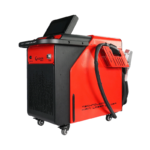
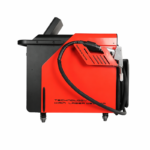
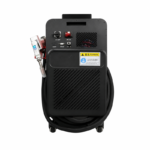
M4 Air-cooled Handheld Fiber Laser Welding Machine
Product Overview
The LNX-M4 is a 1600W air-cooled multi-mode handheld fiber laser welder designed for professional workshops, metal fabricators, and manufacturers handling deep-penetration and high-throughput welding applications.
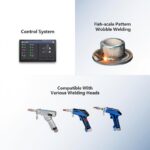
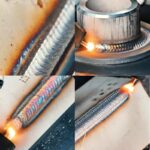
It welds stainless steel, aluminum, and carbon steel with a rated welding depth of up to 4 mm. The air-cooled design requires no separate water chiller, while five integrated modes — continuous, pulse, fish scale, energy storage, and interval — provide flexible options for different fabrication requirements.
The M4 features a BWS20 welding gun, 0.8–1.6 mm single-wire or 1.2–1.6 mm dual-wire feeding, a 20 μm fiber core, and a welding speed of 10–30 mm/s. It is suitable for pressure vessels, heavy machinery, structural fabrication, automotive components, pipelines, shipbuilding, energy storage equipment, metal furniture, and other heavy-duty fabrication applications.
Key Features
1600W Air-Cooled System — High output for deep-penetration welding applications up to 4 mm.
Five Integrated Welding Modes — Continuous, pulse, fish scale, energy storage, and interval welding functions.
Single & Dual-Wire Feeding — Supports flexible filler wire configurations from 0.8–1.6 mm.
The LNX-M4 is a practical choice for businesses seeking a high-output multi-mode laser welding solution with flexible wire feeding for heavy fabrication and production applications.
Technical Specifications
| Parameter | Specification |
|---|---|
| Model No. | LNX- M4 |
| Rated Output Power | 1600W |
| Welding Gun | BWS20 |
| Wire Feeder | Stepper double wire feed |
| Software Functions | Continuous / Pulse / Fish-scale / Energy Storage / Interval |
| Wire Feeding Range | Single 0.8-1.6 / Dual 1.2-1.6mm |
| Welding Speed | 10-30mm/s |
| Function Description | Fish-scale: Welding within 8mm width / Interval: Precise weld spacing control / Energy Storage: Battery-efficient welding |
| Common Welding Materials | Stainless Steel / Aluminum / Carbon Steel |
| Power Consumption | 0.9 kWh/hour |
| Fiber Interface Type | MiniQBH |
| Operating Temperature | -20°C to 45°C |
| Wavelength Range | 1080±10nm |
| Fiber Core Diameter | 20μm |
| Output Fiber Length | 5m |
| Welding Depth | 4mm |
| Power Supply | AC220V 50/60Hz |
| Cooling Method | Air-cooled |
| Total Power Consumption | ≤4500W |
| Dimensions | 516mm × 318mm × 550mm |
| Weight | ≤55kg |
Application Areas
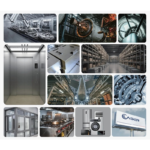
The LNX- M4 Handheld Laser Welder is purpose-built for ultra-heavy industrial welding applications requiring maximum power, penetration depth, and multi-mode flexibility. Ideal applications include: heavy-gauge stainless steel tank and pressure vessel manufacturing with fish-scale aesthetic seams, thick aluminum alloy structural framework welding with precise interval spacing, carbon steel heavy machinery and equipment fabrication, automotive chassis and frame assembly, industrial pipeline and conduit construction with energy-efficient welding, shipbuilding hull plate welding, bridge and infrastructure metalwork, battery and energy storage system manufacturing, metal furniture and architectural fixture production for commercial spaces, and any application requiring deep penetration welding up to 4mm with multi-mode flexibility on ferrous and non-ferrous metals at production-line speeds.
Note: The LNX- M4 represents the ultimate evolution of the M-series handheld laser welders, delivering 100% more power than the M3 while maintaining the same compact 516mm x 318mm x 550mm footprint. With an industry-leading 4mm welding depth capability, all five welding modes (continuous, pulse, fish-scale, energy storage, interval), dual-wire feeding support (1.2-1.6mm), and the fastest welding speeds (10-30mm/s), the LNX- M4 is engineered for ultra-high-volume heavy fabrication where maximum penetration, productivity, and welding versatility are critical. The upgraded 20um fiber core diameter and advanced BWS20 welding gun ensure superior beam quality for deep penetration welding on thick materials across all operating modes.
Technical Resources
Not sure which machine fits your workshop? Explore our laser welding guides and industry insights to make the right choice.
View Technical Guides →