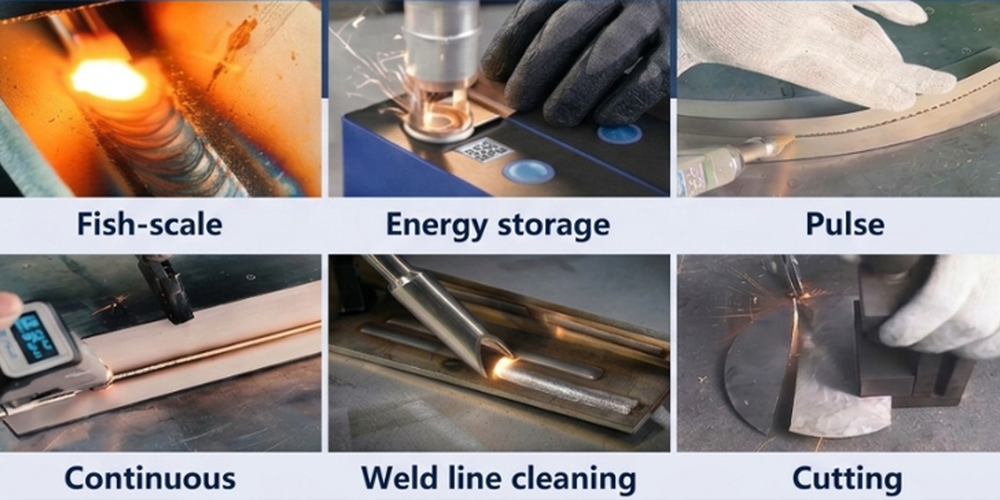
Handheld Fiber Laser Welding vs. TIG Welding

2
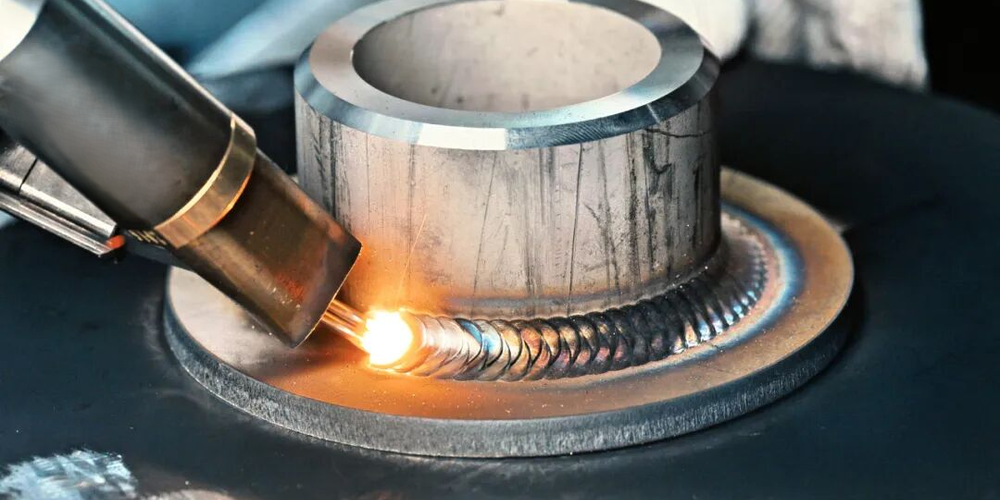
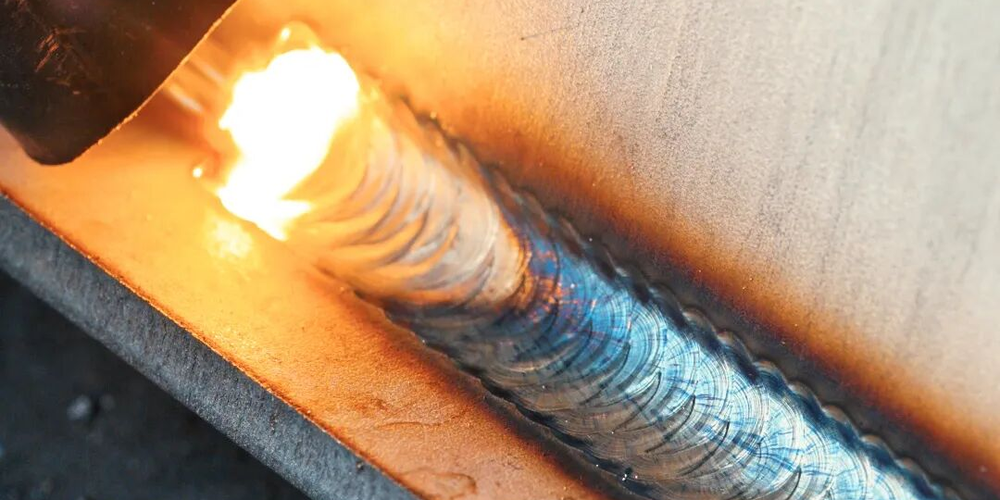
Exquisite Fishscale Welding Effects

The 5 Technical Differences Disrupting Metal Fabrication

A practical decision guide for fabrication shop owners and purchasing managers evaluating the shift from TIG to handheld fiber laser welding.

The Welding Disruption Is Real

If you run a metal fabrication shop in 2026, you have likely heard the claims: handheld fiber laser welders are 4 to 10 times faster than TIG, use 80% less energy, and produce welds so clean they need no post-weld grinding. These are not marketing exaggerations. They are measurable, repeatable outcomes documented across hundreds of fabrication shops worldwide. The question is no longer whether laser welding works. The question is whether your shop can afford to keep relying on TIG as the default.

Key takeaway: Handheld fiber laser welding is not replacing TIG for every application. But for sheet metal fabrication (0.5-5mm), it delivers 2-10x speed, 80% energy savings, and eliminates post-weld finishing — a combination that fundamentally changes shop economics.

This article breaks down the five core technical differences between handheld fiber laser welding and TIG (GTAW) welding, backed by industry data, performance benchmarks, and real-world ROI calculations. Whether you are a shop owner weighing a capital investment or a purchasing manager evaluating suppliers, the data below will help you make an informed decision.

Difference #1: Welding Speed -- 2 to 10 Times Faster

Speed is the most immediately visible advantage of handheld laser welding machine. TIG welding, by design, relies on a tungsten electrode creating an arc that melts the base metal and a separate filler rod. The operator must coordinate torch angle, arc length, filler feed, and travel speed simultaneously. Even experienced TIG welders rarely exceed 0.3-0.8 m/min on common sheet metal thicknesses.

Handheld fiber laser welders use a focused laser beam (typically 1000W-2000W) to melt the workpiece directly. There is no arc to stabilize, no filler rod to coordinate (though wire feed is optional), and no need to oscillate the torch. The operator simply drags the welding gun along the seam. The result:

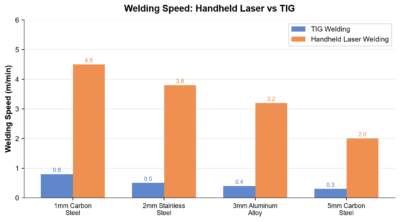
Welding Speed Comparison by Material and Thickness (m/min)
Material & Thickness TIG Speed Laser Speed Speed Ratio
1mm Carbon Steel 0.8 m/min 4.5 m/min 5.6x
2mm Stainless Steel 0.5 m/min 3.8 m/min 7.6x
3mm Aluminum Alloy 0.4 m/min 3.2 m/min 8.0x
5mm Carbon Steel 0.3 m/min 2.0 m/min 6.7x

Welding speed comparison across common materials | LNX Equipment

Figure 1: Welding speed comparison across common materials. Laser welding consistently delivers 5-8x speed gains on thin to medium sheet metal.

These speed figures translate directly to throughput. A shop producing 50 welded assemblies per day with TIG can realistically double or triple output with a laser welder — without adding shifts or operators. The bottleneck simply moves from welding to upstream cutting or downstream packaging.

Real-world example: A custom stainless steel kitchen fabrication shop in Germany reported reducing welding time on a standard sink unit from 22 minutes (TIG) to 4 minutes (1500W laser), a 5.5x improvement. The shop reinvested the saved time into accepting 40% more orders without hiring additional welders.

Difference #2: Weld Quality -- No Grinding, No Polishing

TIG welding produces clean welds relative to MIG or stick welding, but the weld bead still requires significant post-weld processing. Typical TIG welds on stainless steel show discoloration (heat tint), surface oxidation, and minor undercut that must be ground, polished, or pickled before the part is presentable. For shops producing visible-weld products — kitchen equipment, architectural metalwork, medical device housings — this finishing step can consume 30-50% of total production time per part.

Handheld laser welding produces a fundamentally different weld bead. The concentrated heat input (power density of 10^4-10^5 W/mm^2 vs. TIG’s 10^2-10^3 W/mm^2) creates a deep, narrow melt pool with minimal heat spread. The weld seam is smooth, uniform, and visually consistent — often resembling a continuous bright silver line with no discoloration. Most laser-welded seams require zero post-weld finishing.

Weld Quality Comparison: TIG vs. Handheld Laser

Quality Metric TIG Welding Handheld Laser Welding
Weld bead appearance Acceptable, some discoloration Excellent, smooth silver seam
Post-weld grinding needed Yes, 2-10 min per meter No, typically zero
Weld consistency Highly operator-dependent Consistent, repeatable
Porosity risk Moderate (gas coverage dependent) Very low (stable melt pool)
Undercut/overlap defects Common with less-experienced welders Rare
Color match on stainless Requires pickling/passivation No treatment needed

The quality difference is not just cosmetic. Laser welds exhibit more uniform microstructure in the fusion zone due to the rapid heating and cooling cycle. This produces finer grain structures and, in many stainless steel applications, better corrosion resistance at the weld — without the need for post-weld passivation.

For shops producing food-grade stainless steel equipment (kitchen, medical, pharmaceutical), the elimination of post-weld grinding is the single highest-impact benefit. Grinding introduces surface contamination and microscopic scratches that compromise hygiene standards. Laser welding sidesteps this entirely.

Difference #3: Learning Curve -- Hours vs. Months

This is where the labor economics shift most dramatically. TIG welding is widely considered the most skill-dependent manual welding process. A competent TIG welder typically requires 6-12 months of training to produce production-quality welds on stainless steel, and 2-5 years to reach full proficiency across different materials, positions, and thicknesses. This creates a persistent labor bottleneck: skilled TIG welders are expensive, hard to recruit, and difficult to retain.

Handheld laser welding flattens this learning curve to near zero. The operator does not need to strike an arc, control arc length, coordinate a filler rod, or manage torch oscillation. The laser gun is dragged along the seam at a steady pace, and the machine handles energy delivery. Industry data consistently shows:

Training Time and Skill Requirements

Metric TIG Welding Handheld Laser Welding
Basic operation training 2-4 weeks 30-60 minutes
Production-quality welds 3-6 months 1-2 days
Full proficiency 2-5 years 1-2 weeks
Operator certification needed Yes (AWS/CEN) Recommended but not mandatory
Average operator salary (US/EU) $45,000-70,000/yr $30,000-45,000/yr
Cross-material adaptability Requires retraining per material Settings change on touchscreen

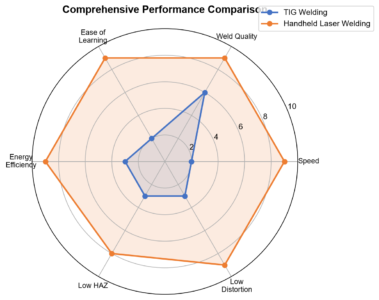
Comprehensive performance radar comparing TIG and handheld laser welding | LNX Equipment

Figure 2: Comprehensive performance radar comparing TIG and handheld laser welding across six operational dimensions. Laser welding dominates in speed, ease of learning, energy efficiency, and distortion control.

The labor implication is significant. A shop that previously needed two certified TIG welders at $60,000/year each can operate with one laser operator at $35,000-40,000/year and produce the same or higher output. The annual labor savings alone ($80,000-$85,000) can pay for a complete laser welding system within the first year.

Difference #4: Energy Consumption and Consumables

TIG welding is energy-intensive. The process relies on maintaining a sustained electric arc at high current (100-300A), which means the power supply draws significant electricity continuously during welding. A typical 300A TIG machine consumes 6-8 kWh per meter of weld on 2mm stainless steel. Add shielding gas (argon at 10-15 L/min), tungsten electrodes, and filler wire, and the per-meter operating cost mounts quickly.

Handheld fiber laser welders are dramatically more efficient. The fiber laser converts approximately 25-30% of input electrical power into laser energy (compared to TIG’s broader but less focused thermal output). More importantly, the laser only consumes power during the actual welding pulse — there is no idle arc to maintain. Industry benchmarks show:

Operating Cost Comparison (per 1,000 meters of weld on 2mm stainless steel)

Cost Item TIG Welding Handheld Laser Savings
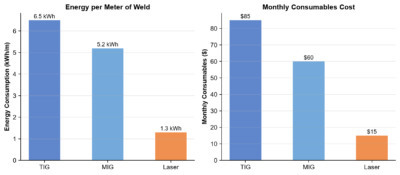
Electricity $520 (6.5 kWh/m) $104 (1.3 kWh/m) 80%
Shielding gas (Argon) $180 $90 (lower flow rate) 50%
Tungsten electrodes $45 $0 (not used) 100%
Filler wire $200 $50 (optional, lower usage) 75%
Grinding consumables $120 $0 (no grinding needed) 100%
Total per 1,000m $1,065 $244 77%

Energy consumption per meter of weld (left) and monthly consumables cost (right) | LNX Equipment

Figure 3: Energy consumption per meter of weld (left) and monthly consumables cost (right). Laser welding consumes 80% less electricity and eliminates tungsten electrode and grinding consumables entirely.

At scale, the savings compound. A shop welding 10,000 meters per year saves approximately $8,200 in direct operating costs. Over a 5-year equipment life, that is $41,000 in operating cost savings alone — before factoring in the labor and throughput gains.

Difference #5: Heat Affected Zone and Material Distortion

The heat affected zone (HAZ) is the region of base metal adjacent to the weld that has undergone microstructural changes due to thermal cycling. A large HAZ means more material is affected, leading to grain growth, softening or hardening, residual stress, and — most critically for fabricators — distortion and warping.

TIG welding produces a wide HAZ because the arc spreads heat laterally into the base metal. On 2mm stainless steel, a typical TIG weld creates a HAZ of 2.5-4mm on each side of the weld seam. This heat spread causes measurable distortion: thin sheets warp, edges pull out of alignment, and flatness tolerances are lost. Shops routinely spend 15-30% of production time on straightening, flattening, and re-aligning TIG-welded parts.

Laser welding’s focused energy beam produces a HAZ of only 0.5-1.5mm — roughly one-third to one-fifth the width of TIG’s. The heat is concentrated in the weld zone and dissipates rapidly, leaving the surrounding material thermally unaffected. The practical outcomes:

Heat Affected Zone and Distortion Comparison (2mm Stainless Steel)

Parameter TIG Welding Handheld Laser Welding
HAZ width 2.5-4.0 mm 0.5-1.5 mm
Heat input (kJ/mm) 0.8-1.5 0.15-0.35
Distortion angle (per meter) 2-5 degrees 0.3-0.8 degrees
Residual stress level High Low to moderate
Post-weld straightening needed Frequently Rarely
Thin sheet warping (<1mm) Common, severe Minimal

For precision fabrication shops producing parts with tight flatness tolerances (e.g., enclosures, panels, frames), the reduction in distortion is often the most valuable benefit. Eliminating post-weld straightening can save more time than the welding speed improvement itself.

The low HAZ also preserves material properties better. For heat-treated alloys, work-hardened materials, or corrosion-resistant grades, the smaller thermal footprint means the base metal retains its designed properties closer to the weld — a critical factor in structural and pressure-retaining applications.

The ROI Reality: When Does the Investment Pay Off?

A typical 1500W handheld fiber laser welding system costs $8,000-$15,000 depending on configuration, accessories, and certification level. A comparable industrial TIG setup costs $2,000-$5,000. At first glance, the laser requires 2-3x the upfront capital. But the total cost of ownership tells a very different story. For a detailed specification breakdown of our K Series 1600W air-cooled handheld laser welder, see the K4 product page.

Consider a mid-sized fabrication shop welding approximately 500 meters per week on 1-3mm stainless steel and carbon steel:

24-Month Total Cost of Ownership Comparison

Cost Category (24 months) TIG Operation Laser Operation
Equipment purchase $3,500 $12,000
Labor (1 operator) $120,000 $80,000
Electricity $12,480 $2,496
Consumables (gas/wire/electrodes) $9,600 $2,400
Post-weld finishing labor $24,000 $2,000
Rework/scrap from defects $6,000 $1,500
Total 24-month cost $175,580 $100,396
Net savings vs. TIG — $75,184

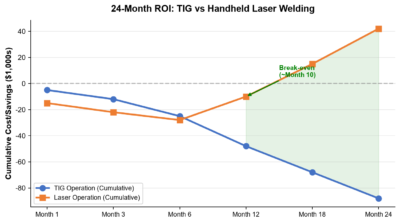
24-month cumulative cost trajectory | LNX Equipment

Figure 4: 24-month cumulative cost trajectory. Despite higher upfront equipment cost, laser welding reaches break-even at approximately month 10 and generates positive returns thereafter.

The break-even point falls around month 10. From that point forward, every additional month of operation generates net positive cash flow compared to the TIG alternative. Over a typical 5-year equipment lifespan (fiber laser sources are rated for 100,000+ hours of operation), the total savings can exceed $180,000.

When to Choose Laser -- and When TIG Still Wins

Handheld laser welding is transformative, but it is not universal. Understanding its boundaries is critical for making the right investment decision.

Choose Handheld Laser Welding When:

  • Primary materials are 0.5-5mm sheet metal (stainless steel, carbon steel, aluminum, copper)
  • Production volume requires high throughput and consistent quality
  • Post-weld finishing (grinding, polishing) is a significant cost center
  • Skilled TIG welders are hard to recruit or retain
  • Visible weld aesthetics matter (architectural, kitchen, medical equipment)
  • Distortion control is critical for part tolerances
  • Shop wants to expand capacity without expanding headcount

TIG Welding Remains Superior For:

  • Thick materials (>6mm) where deep penetration and multi-pass welding are needed
  • Exotic metals (titanium, magnesium alloys) requiring precise heat control
  • Root passes on pipe welding where back-side penetration control is critical
  • Field repairs and outdoor work where portability and wind resistance matter
  • Very low-budget operations where upfront capital is constrained
  • Applications requiring ASME or other code certifications not yet approved for laser welding

Most successful fabrication shops do not replace TIG with laser — they add laser alongside TIG. The laser handles 70-80% of production volume (thin to medium sheet metal), while TIG is reserved for thick materials, field repairs, and specialized applications. This hybrid approach maximizes both utilization and ROI.

 

The LNX Equipment Solution

LNX Equipment supplies CE-certified fiber laser welding systems sourced from qualified manufacturers and rigorously back-checked for specification accuracy, export certification, and production reliability. Two primary configurations address different fabrication shop needs:

LNX Equipment Laser Welder — Core Specifications at a Glance

Parameter K1 (1600W) S6 (2000W)
Rated Power 1600W 2000W
Welding Depth 4mm <=6mm
Cooling Air-cooled Water-cooled
Weight <=55kg 180 +/- 20kg
Dimensions 516 x 318 x 550mm 1032 x 652 x 1240mm
Power Supply AC220V 50/60Hz AC220V 50/60Hz

The K4 is a handheld air-cooled unit built around the BWS20 welding gun with dual-wire stepper feeding and fish-scale welding capability within 8mm width. At <=55kg, it is the optimal choice for workshops prioritizing portability and fast setup. The S6 is a desktop benchtop system with 2000W continuous-wave output, QBH/RD dual fiber interface, and 50um fiber core. Its 10m output fiber length and 6mm welding depth make it suitable for stationary heavy-industrial applications including tank fabrication and pressure vessels. Both units run on standard single-phase AC220V power with no three-phase upgrade required.

Take the Next Step

The shift from TIG to handheld laser welding is not a trend — it is a measurable productivity transformation that is reshaping fabrication economics worldwide. Shops that adopt early gain compounding advantages: higher throughput, lower costs, reduced labor dependency, and superior product quality that wins more contracts.

Get a Custom Quote | Explore K4 Specifications

Request a Free Sample Weld Test

Send us your material samples or specifications, and we will weld them with our K4 (1600W handheld) or S6 (2000W desktop) system and ship the results back to you. Seeing and touching a laser-welded seam is worth more than any specification sheet.

Contact us today:

  • Website: lnxequipment.com
  • Email: [email protected]
  • WhatsApp: +86 185 0728 8166
  • Request a product brochure or technical datasheet

Limited offer: Free material sample welding test for qualified fabrication shops. Contact us with your material type, thickness, and joint configuration to receive a welded sample within 5-7 business days.

The data is clear. The technology is proven. The question is whether your shop will be among the early adopters gaining competitive advantage — or among the late movers catching up.

View the LNX Series of Handheld Laser Welding Machines

2 thoughts on “Handheld Fiber Laser Welding vs. TIG Welding”

  1. Jarvis says:

    The technical articles about handheld fiber laser welding on your website are very professional and informative. The analysis of equipment selection, air‑cooled vs water‑cooled models, and the comparison between laser welding and TIG welding provides great practical reference. We are investigating the procurement of handheld laser welding equipment. Could you please send us complete product specifications, quotations and on‑site application cases? Looking forward to your reply, thank you!

    1. Thank you for your recognition and support of LNX. We offer a full range of in-house developed laser welding machines with power ratings from 350W to 3000W, along with comprehensive after-sales support. We have helped many small and medium-sized factories significantly improve their welding efficiency, thereby reducing labor costs and training time. Even those with no prior experience can quickly get up to speed. We will contact you via email to provide detailed product information, a quote, and usage guidelines. Please check your email shortly. Thank you again!

Leave a Reply

Your email address will not be published. Required fields are marked *