Understanding the Wire Feeder's Role in Handheld Fiber Laser Welding:
Unlike TIG or MIG welding where the wire is the electrode, in laser welding the filler wire is strictly auxiliary. The laser beam itself generates the molten pool. The wire feeder adds material to that pool to fill gaps, reinforce joints, or improve bead cosmetics.
This means two things. First, the wire feeder’s precision matters more than its raw speed. A deviation in wire positioning relative to the laser spot can create underfill or excess reinforcement. Second, the wire’s alloy composition and diameter must be tightly matched to the base material—mismatch here causes porosity, cracking, or poor fusion regardless of how powerful your handheld fiber laser welding machine is.
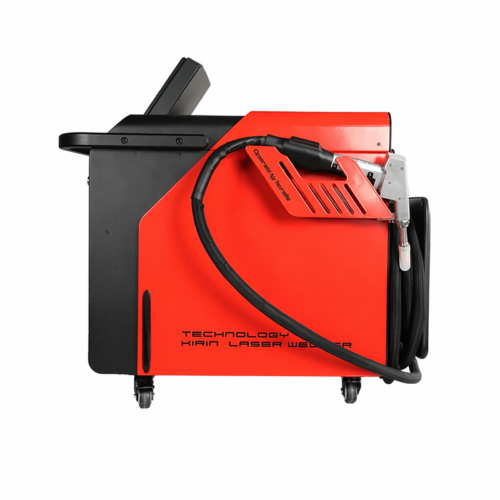
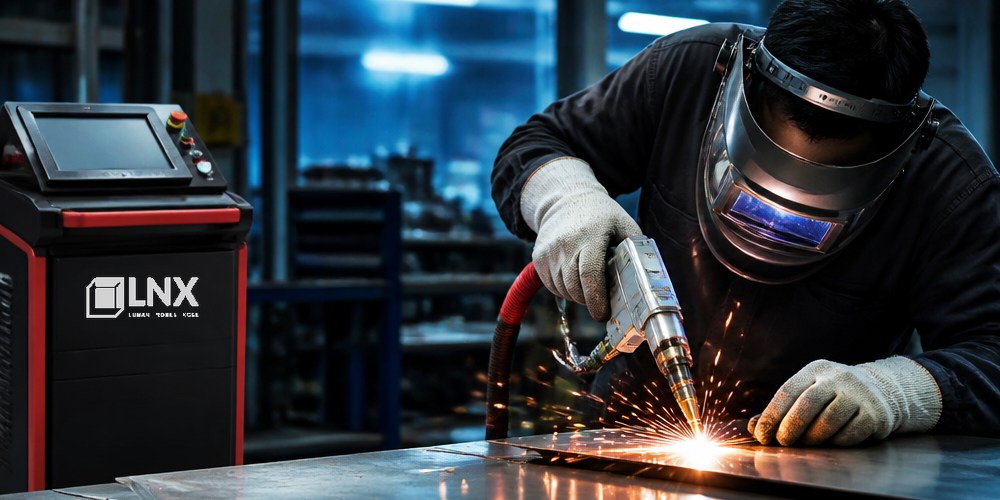
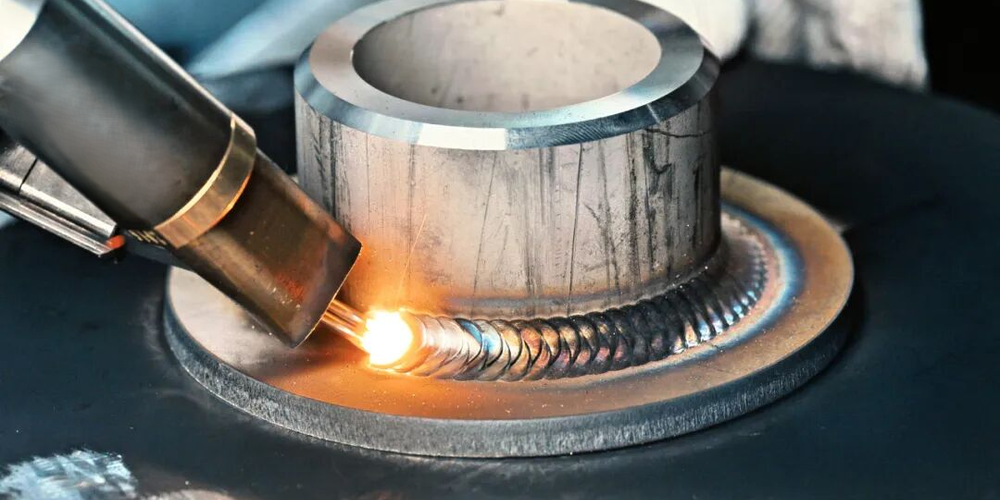
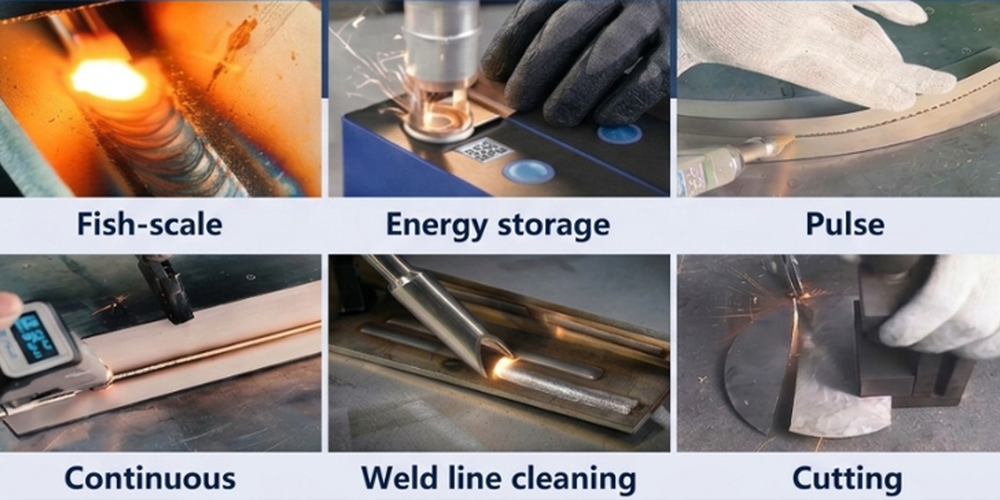
Fig 1. LNX M3 handheld fiber laser welding machine—800W air-cooled, stepper double-wire feeding system, five welding modes including fish-scale.
Single-Wire Feeder: The Standard Baseline:
A single-wire feeder uses one drive motor to push a single filler wire toward the weld zone. It is the simplest, most cost-effective configuration and handles the majority of applications in general fabrication.
What it does well: In butt joints with tight fit-up (gap < 0.5mm), the single wire adds just enough material to ensure full penetration without overbuilding the bead. On thin stainless steel (0.3-2mm), where heat input must stay low, a single 0.8-1.0mm wire at controlled feed rate produces a clean, flat seam that often needs no post-grinding.
Where it struggles: When joint gaps exceed 0.8mm, a single wire either cannot deposit enough volume to fill the void, or must be fed so aggressively that it disrupts the molten pool stability. The result is porous welds, inconsistent penetration, or excessive convexity that requires costly rework.
Application scenario: A metal furniture shop welding 1.5mm 304 stainless tube for outdoor railings. Their joints are machine-cut with < 0.3mm gaps. A single-wire 350W-800W handheld fiber laser welding machine with 0.8mm ER308L wire delivers production-rate output with zero post-processing. Adding a dual-wire system here would add cost and complexity with zero quality gain.
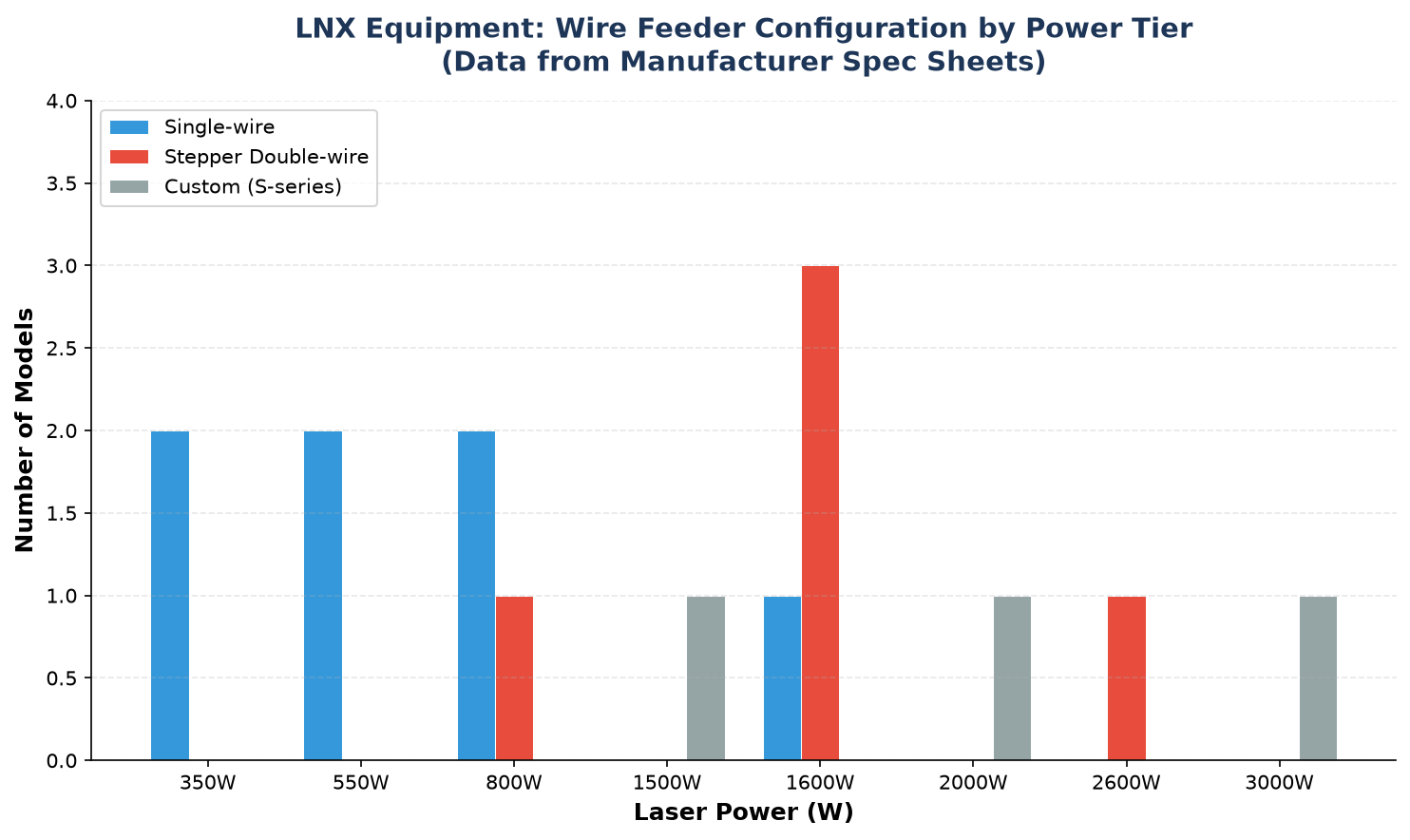
LNX Equipment models with single-wire feeders include the K1, F1, K2, F2, K3, F3, and F4—covering the 350W to 1600W range with wire diameters from 0.8mm to 1.6mm depending on power tier.
Stepper Double-Wire Feeder: When Precision Meets Volume:
Stepper double-wire systems use two synchronized motors to feed two wires into the weld zone simultaneously. “Stepper” refers to the motor type: stepper motors rotate in discrete angular increments, enabling precise speed control that maintains synchronization even when wire resistance varies.
The dual-wire approach serves three distinct purposes on a handheld fiber laser welding machine:
- Gap bridging: Two wires deposit more filler volume than a single wire at the same total feed rate. For joints with 0.5-1.2mm gaps, this eliminates the need for tack-welding or part re-fixturing.
- Thick plate reinforcement: On 3-6mm carbon or stainless steel, dual wires create a wider, flatter reinforcement profile. This reduces stress concentration at the toe of the weld and improves fatigue resistance in structural applications.
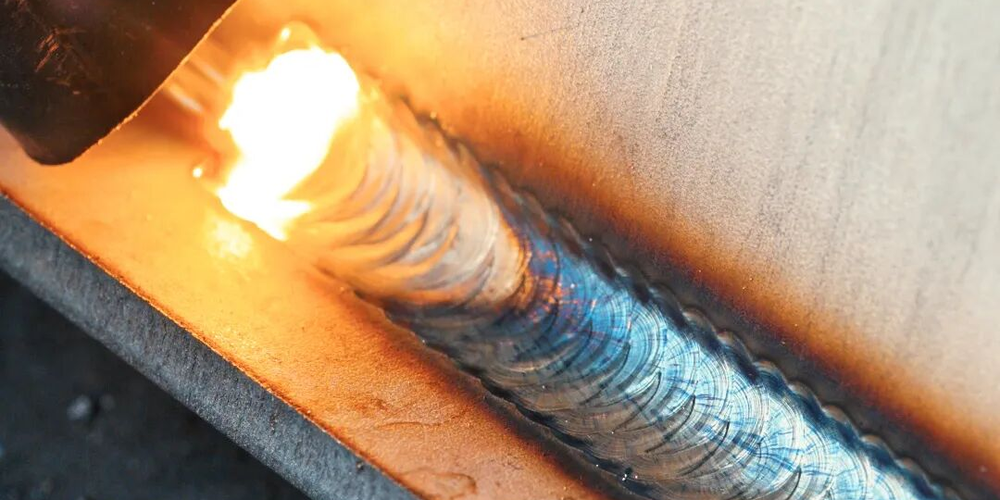
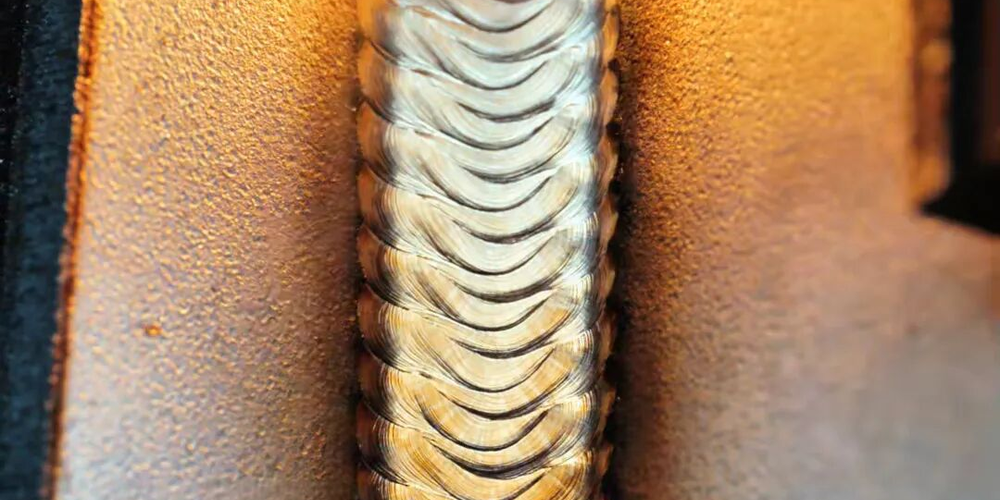
Cosmetic control: The synchronized dual-wire configuration, when paired with pulse or fish-scale mode software, produces the decorative “fish-scale” patterns visible on high-end kitchen equipment and architectural metalwork. The second wire fills the weave pattern while the first stabilizes the root.
Technical reality check: Dual-wire feeding requires precise coordination. If the two motors drift out of sync, the bead becomes asymmetric—one side convex, the other concave. This is why stepper motor control (with closed-loop feedback in premium systems) matters more than simply having “two wires.”
Application scenario: A fabrication shop producing 3mm stainless commercial kitchen sinks. Their supplier-delivered sheet has ±0.8mm cut tolerance, creating variable gaps at corners. With a stepper double-wire 800W-1600W handheld fiber laser welding machine and 1.2mm ER308L wire, they bridge those gaps in a single pass without pre-tacking, cutting cycle time.
LNX Equipment models with stepper double-wire feeders include the M3, M4, K4, F4S, and F6—spanning 800W to 2600W with wire ranges supporting 0.8-1.6mm single and 1.2-1.6mm dual configurations.
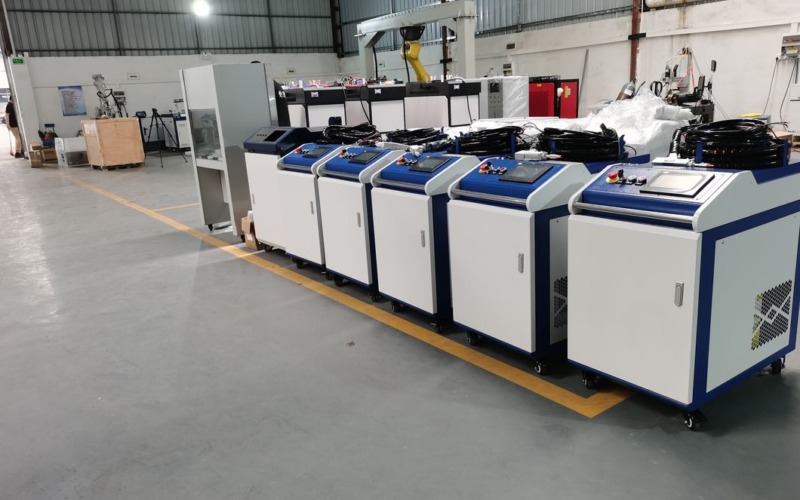
Fig 2. Factory floor lineup of handheld laser welders. Stepper double-wire systems are increasingly standard on mid-to-high-power models for gap bridging.
Quad-Wire Feeder: The Frontier for Complex Welding:
Quad-wire systems feed four independent wires into the weld zone, typically controlled by four separate motors with individual speed programming. This technology has emerged for both automated laser welding stations and, more recently, handheld applications.
The use case for quad-wire is highly specific: large gap tolerance (1.5-3mm), multi-pass deposition welding, or situations where the joint geometry changes along the seam and the filler volume must adapt dynamically. For example, welding automotive battery tray frames where stamped aluminum parts have inconsistent gap profiles along a 2-meter seam.
Industry sources confirm that quad-wire handheld welding heads are already entering the market from specialized Chinese manufacturers. However, the practical constraints remain significant: four wire spools, four motors, and four feed-line tensioners add considerable weight and bulk to the handheld unit. Operators report increased fatigue during extended welds, and the software algorithms to coordinate four independent feed rates in real time require either preset programs or sensor feedback that handheld units still struggle to provide reliably.
In the automated welding space, several European and Chinese industrial suppliers have developed multi-wire feeding systems for laser brazing and welding in automotive production, where seam consistency on visible joints must be paint-ready. These systems typically use grouped motor control (A/B and C/D pairs) to achieve synchronized feeding with adjustable retract length, delay compensation, and speed ramp parameters.
For handheld applications, quad-wire is technically feasible but operationally demanding. It remains a specialized tool for experienced welders working on high-tolerance, large-gap joints—not a general-purpose upgrade from double-wire on a standard handheld fiber laser welding machine.
Selection Framework: Match the Feeder to the Joint, Not the Power:
The most common mistake we see: buyers select wire feeder configuration based on budget or power tier, not on the actual joint characteristics of their work. Here’s the decision logic that actually works.
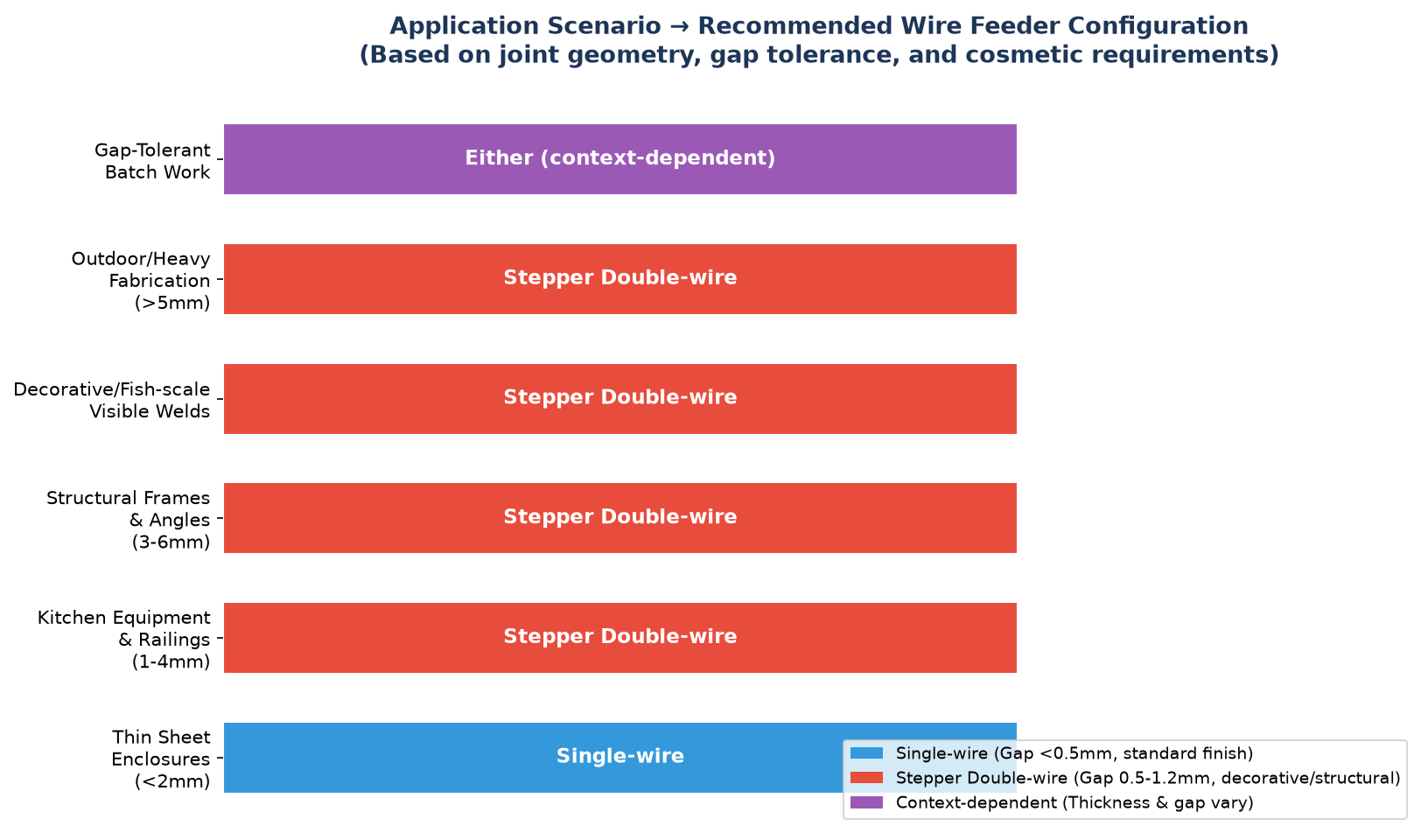
If your typical joints have gaps < 0.5mm, material thickness < 3mm, and cosmetic requirements are standard (not decorative): Single-wire is sufficient. Do not pay the premium for dual-wire capability you will not use.
If your typical joints have gaps 0.5-1.2mm, material thickness 2-6mm, or you produce visible decorative welds (kitchen, railing, signage): Stepper double-wire is the practical choice. The gap-bridging and cosmetic control justify the added cost.
If you are welding structural joints with gaps > 1.5mm, or if you need adaptive filler deposition along variable-gap seams: Quad-wire systems are emerging as an option for handheld use, but consider whether your operators have the skill and stamina to manage the added complexity. For fully automated cells, quad-wire is already proven in automotive and battery manufacturing.
One final note on wire specification: Always match wire alloy to base material. For 304 stainless, use ER308L. For 316L, use ER316L. For carbon steel, ER70S-6. For aluminum, ER4043 or ER5356 depending on alloy series. Using the wrong wire alloy with the right feeder configuration still produces defective welds. The feeder controls delivery; the wire controls metallurgy.
Bottom Line:
The wire feeder is not an accessory on a handheld fiber laser welding machine. It is a process-critical subsystem that determines whether your machine performs as advertised on your specific parts. Single-wire covers most thin-material, tight-fit work. Stepper double-wire unlocks gap bridging and decorative welding. Quad-wire is the newest frontier—technically proven in automation, increasingly available for handheld, but operationally demanding.
Before you buy, audit your actual joint geometry for 50 consecutive parts. Measure the maximum gap, the material thickness range, and whether the welds are visible to end customers. Then match the feeder configuration to those facts—not to the brochure’s feature list.