Cost & ROI Series | Article 3
Series note: Article 1 explained why cost should be measured per accepted meter. Article 2 explained how to measure efficiency and throughput. This article connects material, thickness, joint design and production duty to the right handheld laser welding machine configuration.
Quick answer: Choose a handheld laser welding machine by starting with the material, production thickness, joint type and duty cycle. Rated welding depth is only a machine parameter; it is not a guarantee of full penetration on every joint. LNX Equipment recommends confirming K, M, F or S series candidates with a test weld on the customer’s material and fixture.
Power is easy to compare. Fit is harder.
A 1600W machine may be ideal for one shop and oversized for another. A 350W unit may be perfect for thin stainless steel yet unsuitable for a production shop welding 4 mm lap joints. The right selection depends on the work package, not the largest number on a specification sheet.
This guide gives small and mid-sized metal fabricators a practical selection framework. It covers common materials, thickness planning, joint design, cooling, K and M series positioning, heavy-section S series options, and a pre-quotation checklist.
Start with the work, not the wattage
Before asking which machine is best, define the work it must perform. The buying decision should answer these questions:
- Which materials and grades will be welded?
- What is the normal production thickness, not the occasional maximum?
- What joint type will be used: butt, lap, fillet, corner or edge?
- What penetration and weld size are required?
- How many meters or parts are produced per shift?
- How many hours per day will the machine run?
- What surface finish is required?
- Is the machine moved between workstations?
- What power supply and floor space are available?
- Who will support training, spare parts and maintenance?
The answers usually narrow the specification quickly. A complete quotation should repeat those requirements, because a machine selected for thin decorative work should not be compared directly with a system selected for heavy structural fabrication.
Material selection: what changes the decision
Handheld fiber laser welding can be used on several ferrous and non-ferrous metals, but each material brings different preparation, reflectivity, thermal and quality risks.
| Material |
General suitability |
Main selection focus |
What to verify |
| Stainless steel |
Strong fit for many thin and medium-gauge applications |
Fit-up, heat tint, distortion and appearance |
Grade, thickness, gas, mode and cleaning requirement |
| Carbon steel |
Strong fit when the surface is clean and the joint is controlled |
Surface condition, gap, penetration and distortion |
Rust, oil, mill scale and weld procedure |
| Galvanized steel |
Conditional; zinc coating can affect weld quality and fume |
Coating removal in the weld zone, extraction and process control |
Porosity, spatter, coating condition and local safety rules |
| Aluminum |
Conditional to strong, depending on alloy and thickness |
Cleaning, gap, heat input and penetration |
Alloy, surface oxide, gas, power and mode |
| Copper and copper alloys |
Application-specific |
Reflectivity, thermal conductivity and joint design |
Test coupon, procedure and acceptance criteria |
| Dissimilar metals |
Application-specific |
Intermetallic formation, cracking and service requirements |
Material combination, filler selection and testing |
TWI explains that laser welding is a fusion process and that material preparation and parameters influence defects such as porosity, cracking and loss of toughness. TWI also publishes that aluminum welding requires control of porosity and process conditions rather than simple power selection.
This is why a general “multi-material” claim is not enough. Ask for a parameter recipe and test result for the actual material combination.
Figure 1:Material selection matrix / Handheld fiber laser welding — first-pass suitability by material
Thickness selection: use rated depth as a starting point
Manufacturers usually publish a rated or maximum welding depth. It is useful for shortlisting, but it does not answer every production question.
A rated 4 mm welding depth may mean different things for:
- A butt joint with tight fit-up.
- A lap joint with a gap.
- A fillet weld with a large throat requirement.
- A production weld that runs continuously for hours.
- A weld that needs full penetration and a specific appearance.
For production planning, use the rated depth as an upper boundary and confirm the achievable process window on the real joint. Keep a margin for material variation, gap, surface condition and duty cycle.
The LNX air-cooled model ladder provides a practical starting point:
| Production target |
Candidate model |
Rated output |
Rated depth |
Listed speed |
| Thin sheet and precision work |
K1 |
350W |
1.5 mm |
2–10 mm/s |
| Light fabrication |
K2 |
550W |
2 mm |
2–10 mm/s |
| Thin-to-medium stainless and sheet metal |
K3 |
800W |
3 mm |
5–20 mm/s |
| Medium-gauge production and multi-mode work |
K4 |
1600W |
4 mm |
10–30 mm/s |
These are model specifications, not a guarantee that every joint will achieve the rated depth. Full penetration, weld width and appearance must be validated.
K series model by model
The K series is the compact air-cooled range. It is generally suited to workshops that need mobility, simple operation and moderate production duty.
| Model |
Power |
Rated depth |
Modes |
Wire feed |
Best starting point |
| K1 |
350W |
1.5 mm |
Continuous / pulse |
Single 0.8–1.0 mm |
Very thin sheet, repair and precision work |
| K2 |
550W |
2 mm |
Continuous / pulse |
Single 0.8–1.0 mm |
Light stainless and sheet metal |
| K3 |
800W |
3 mm |
Continuous / pulse |
Single 0.8–1.6 mm |
General thin-to-medium fabrication |
| K4 |
1600W |
4 mm |
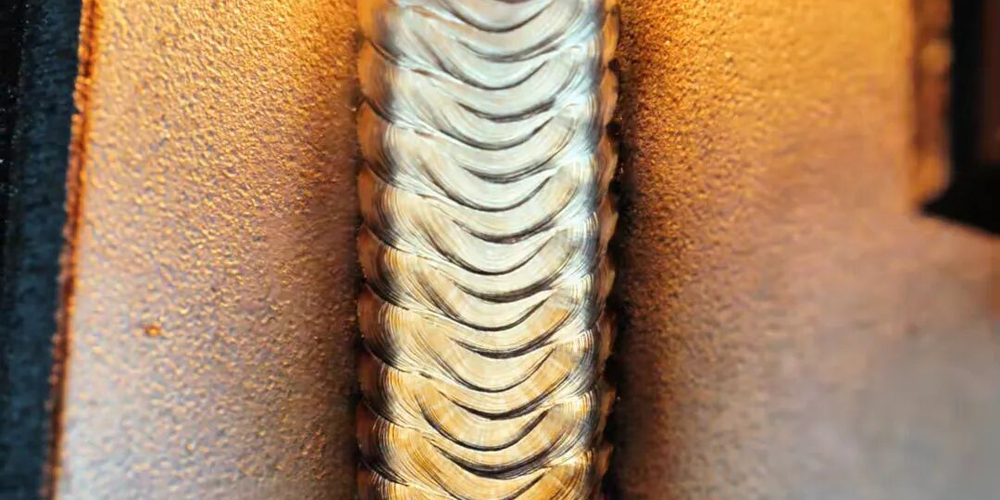
Continuous / pulse / fish-scale |
Single 0.8–1.6 / dual 1.2–1.6 mm |
Higher-output air-cooled production and visible seams |
K1 and K2 are better viewed as precision or light-duty machines. K3 is often the practical starting point for general stainless and sheet-metal work. K4 adds more output, dual-wire capability and fish-scale mode, but the correct choice still depends on duty cycle and joint requirements.
M series positioning
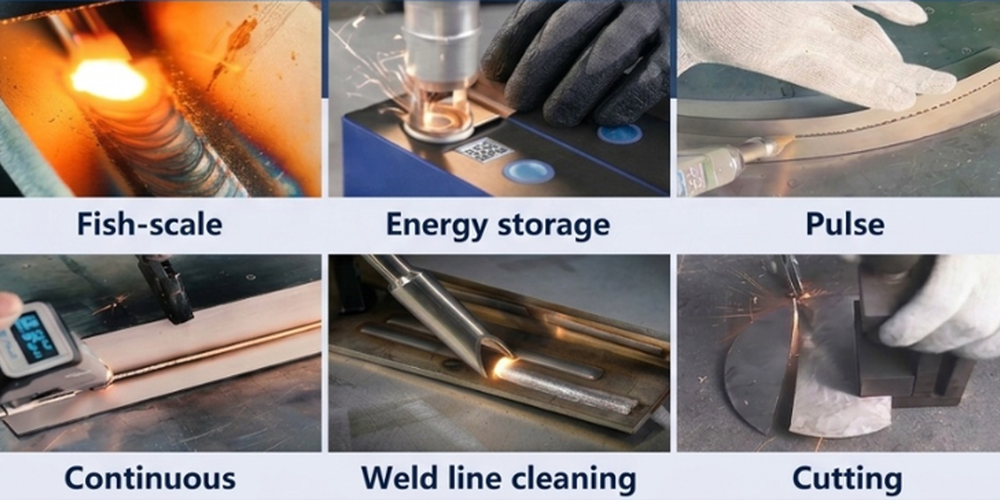
The M series is positioned for workshops that need more process flexibility. The main difference is not simply power; it is the five-mode control set and the ability to match the mode to thin sheet, visible seams, controlled energy delivery and interval welding.
| Model |
Power |
Rated depth |
Modes |
Wire feed |
Positioning |
| M3 |
800W |
3 mm |
Continuous / pulse / fish-scale / energy storage / interval |
Stepper wire feed |
Multi-mode work at moderate thickness |
| M4 |
1600W |
4 mm |
Continuous / pulse / fish-scale / energy storage / interval |
Single 0.8–1.6 / dual 1.2–1.6 mm |
Higher-output multi-mode fabrication and mixed part families |
Choose M3 when the work is within its thickness range and mode flexibility matters more than maximum output. Choose M4 when the shop needs more output, dual-wire capability and a wider range of mode combinations.
Do not choose M4 only because it has more power. If the production thickness is low and the duty cycle is light, a smaller K or F model may be easier to move, easier to power and sufficient for the work.
F series: entry-level and general-purpose alternatives
The F series overlaps with the K series but offers additional model choices and some higher-output air-cooled options.
- F1: 350W, 1.5 mm rated depth, continuous and pulse.
- F2: 550W, 2 mm rated depth, continuous and pulse.
- F3: 800W, 3 mm rated depth, continuous and pulse.
- F4: 1600W, 4 mm rated depth, continuous and pulse.
- F4S: 1600W, 4 mm rated depth with fish-scale mode.
- F6: 2600W air-cooled model with 6 mm rated depth and five modes.
The F6 is a bridge between the compact air-cooled range and the heavier water-cooled S series. It can be considered when the shop needs deeper penetration but wants to avoid a separate water chiller. Confirm the power supply, weight, extraction and duty cycle before selecting it.
S series: water-cooled systems for heavier work
The S series uses water cooling and a stationary benchtop format. It is intended for heavier sections, sustained duty and applications where an air-cooled handheld unit reaches its practical limit.
| Model |
Power |
Rated depth |
Cooling |
Typical selection signal |
| S5 |
1500W |
≤5 mm |
Water-cooled |
Thick stainless or carbon steel with moderate-to-high duty |
| S6 |
2000W |
≤6 mm |
Water-cooled |
Heavier fabrication and deeper penetration |
| S7 |
3000W |
≤7 mm |
Water-cooled |
Heavy-gauge structural, tank, vessel and thick-section work |
The S7 requires AC380V three-phase power and weighs approximately 220 kg. It is not a replacement for a compact handheld unit when mobility is the priority. It is a different class of work cell.
Before selecting an S model, confirm:
- Joint preparation and fit-up.
- Required penetration and weld size.
- Floor space and power supply.
- Cooling water and maintenance plan.
- Extraction and safety controls.
- Expected duty cycle and production flow.
Figure 2: Power selection by production thickness / Starting power class for planning
Air-cooled or water-cooled?
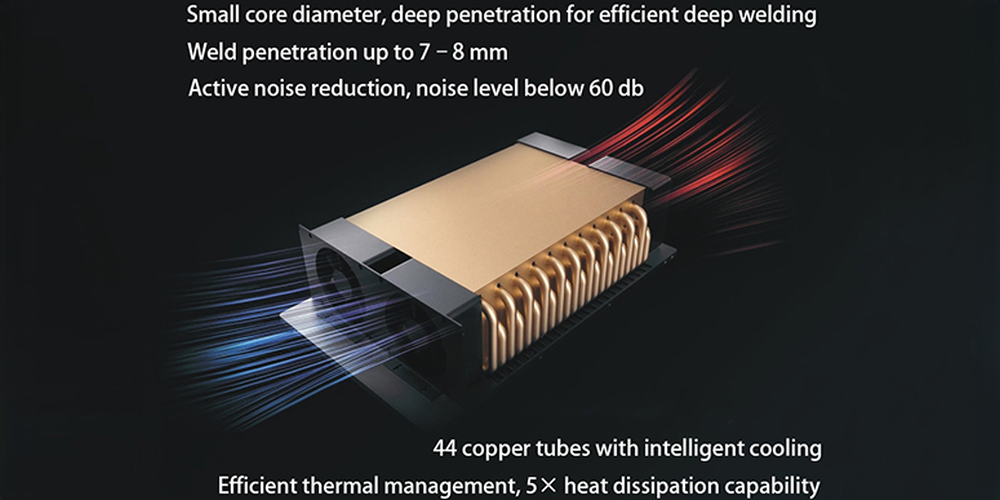
Air-cooled machines are easier to move, simpler to install and well suited to mixed, intermittent, field or space-limited work. Water-cooled systems add a chiller, more weight and a fixed workstation footprint, but they provide thermal headroom for heavier and more sustained production.
The decision is not “which cooling method is better.” It is “which cooling method matches the work cycle?”
| Selection question |
Air-cooled direction |
Water-cooled direction |
| Normal thickness |
Compact models commonly cover thin to about 4 mm; F6 extends toward 6 mm |
Water-cooled models cover sustained work from about 5–7 mm |
| Duty cycle |
Intermittent production, mixed jobs and short batches |
Long shifts, sustained output and high-value cells where downtime matters |
| Mobility |
Frequent movement between benches or sites |
Fixed industrial workstation or heavy benchtop installation |
| Environment |
Good airflow and controlled dust |
High ambient temperature, heavy duty or long continuous runs |
| Power supply |
Often single-phase for compact models |
Some high-power models require three-phase power |
| Main risk |
Overheating during sustained high-output work |
Higher installation and maintenance scope |
The overlap around 4–5 mm is important. S5 is a 1500W water-cooled model rated up to 5 mm, while K4, M4 and F4 are 1600W air-cooled models rated up to 4 mm. The final choice depends on duty cycle, joint, ambient temperature and the required process window, not the cooling label alone.
Air-cooled selection signals
Air cooling is often the better starting direction when:
- The work is mostly 0.3–4 mm stainless, carbon steel or galvanized sheet.
- The machine moves between benches, sites or workstations.
- Production is intermittent rather than a continuous line.
- The shop has limited floor space for a separate chiller.
- The buyer needs to validate demand before investing in a heavier production cell.
Air cooling does not mean thin plate only. A higher-output model may pass a thick test coupon, but the question is whether it repeats that result through the full shift without drift or overheating.
Water-cooled selection signals
Water cooling is often the better starting direction when:
- Normal production thickness is 5 mm or more.
- The machine runs for long shifts or supports a production bottleneck.
- The shop needs a fixed industrial workstation.
- Aluminum or copper requires more thermal and power margin.
- The application is pressure vessels, heavy structures, shipbuilding, mining equipment or similar work.
Water cooling adds installation and maintenance scope. Confirm chiller space, cooling liquid, ambient conditions and service access before purchase. Do not choose water cooling because it sounds more industrial; choose it because the duty cycle requires it.
Validate the duty cycle, not just the first weld
A short thick-section test does not prove sustained production performance.
Run a duty-cycle test using the real material, joint and thickness:
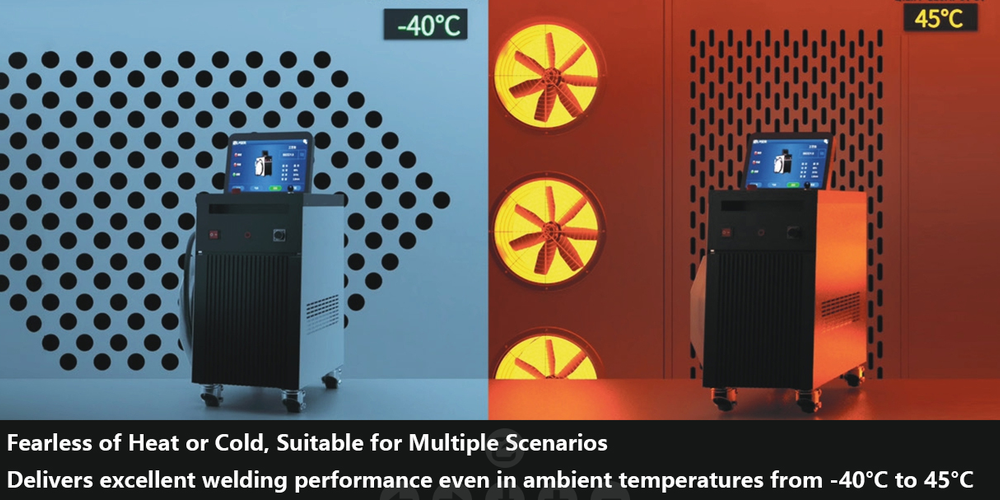
- Use the highest expected ambient temperature.
- Run for the same duration as the normal production shift.
- Record penetration and appearance at the start, middle and end.
- Watch for overheating, power drift or recovery delays.
- Inspect the last part to the same standard as the first.
- Record the time required to return to normal operation.
This is especially important in hot, dusty or poorly ventilated workshops. Air-cooled systems depend on airflow and ambient conditions. Water-cooled systems require a functioning chiller and clean cooling loop.
High-reflectivity materials
Aluminum and copper are not selected from a steel thickness chart. High reflectivity and thermal conductivity can change the usable process window and may require additional power margin, different preparation and procedure testing.
Use the exact alloy, thickness, joint and filler combination. Verify penetration, porosity and appearance on a test coupon. Do not assume that a 3000W machine delivers the same depth on every aluminum grade or joint configuration.
Avoid both errors:
- An undersized air-cooled machine may not sustain heavy production.
- An oversized water-cooled machine may be harder to control on thin sheet and unnecessary for intermittent work.
For a deeper comparison, read the LNX air vs water cooling guide.
Match the joint and wire feeder
The same laser power can produce very different results depending on joint type and fit-up.
- Butt joint: requires tight gap control and good penetration.
- Lap joint: benefits from controlled penetration and stable clamping.
- Fillet joint: requires correct angle, wire feed and weld size.
- Corner joint: depends on fit-up and access.
- Visible decorative seam: may use fish-scale or pulse modes and requires appearance control.
If the gap is variable, filler wire can improve fit-up tolerance and help control solidification cracking. TWI notes that cold wire feed can reduce welding speed by approximately 10% to 20% at a given power because energy is required to melt the wire. The correct feeder is the one that matches the joint, not the one with the largest number of wires.
For the full feeder selection logic, read Wire Feeder Systems Explained.
Choose by production duty, not only thickness
A shop welding one 3 mm part per day has a different requirement from a shop welding 10,000 meters of 3 mm stainless per year.
Use these four duty profiles:
Occasional repair and custom work
Prioritize mobility, simple controls and quick setup. A smaller K or F model may be sufficient.
Mixed thin-sheet production
Prioritize mode flexibility, wire feed and repeatable fixtures. K3, M3 or F3 may be candidates.
Medium-gauge production
Prioritize output, duty cycle, dual-wire capability and cooling. K4, M4, F4 or F4S may be candidates.
Heavy or sustained fabrication
Prioritize penetration, water cooling, power supply and service support. S5, S6 or S7 may be candidates.
Power selection in plain numbers
Use the following table as a starting point, not as a purchase guarantee:
| Production thickness |
Starting power class |
Candidate models |
Important check |
| Up to 1.5 mm |
350W |
K1 / F1 |
Distortion, fit-up and appearance |
| Around 2 mm |
550W |
K2 / F2 |
Penetration and gap |
| Around 3 mm |
800W |
K3 / F3 / M3 |
Duty cycle and mode requirement |
| Around 4 mm |
1600W |
K4 / F4 / F4S / M4 |
Joint type, wire feed and cooling |
| Around 6 mm |
2600W |
F6 |
Power supply and duty cycle |
| 5–7 mm |
1500–3000W |
S5 / S6 / S7 |
Water cooling, fixture and penetration validation |
Pre-quotation self-check
Before asking a supplier for a recommendation, complete this checklist:
- Material and grade: __________
- Normal thickness and maximum thickness: __________
- Joint type and required penetration: __________
- Annual accepted weld length or parts: __________
- Shift pattern and duty cycle: __________
- Surface finish and cleaning requirement: __________
- Available power supply: __________
- Machine mobility requirement: __________
- Cooling space and maintenance capability: __________
- Operator experience: __________
- Extraction and safety requirements: __________
- Spare parts and support requirement: __________
If these answers are not available, a proposed model is only an assumption. A professional selection process should include a test weld, measured penetration and a quality acceptance record.
Common selection mistakes
- Choosing the highest power without defining the joint.
- Comparing rated depth with production thickness without a penetration test.
- Ignoring duty cycle and cooling.
- Selecting a machine that is too heavy or too large for the work cell.
- Choosing on purchase price rather than TCO and support.
- Using a single parameter recipe for different materials.
- Assuming no-grind welding will work on every seam.
- Buying without confirming training, spares and response time.
- Testing only a clean, perfect demonstration coupon.
- Failing to define who approves the final weld quality.
FAQ
Which handheld laser welding machine is suitable for 3 mm stainless steel?
K3, F3 or M3 800W models are reasonable candidates for a 3 mm rated depth, but suitability depends on joint type, penetration, duty cycle and appearance. M3 adds five-mode flexibility. If the production thickness is near 3 mm at high duty, test the machine and consider whether water cooling is more appropriate.
Should I choose air-cooled or water-cooled?
Choose air-cooled for mobility, lighter duty and mixed workstation work. Choose water-cooled for sustained output, heavier sections and fixed production cells. Match the machine to the real duty cycle, power supply, environment and maintenance capability. A test weld and thermal trial are more useful than a generic claim that one cooling method is always better.
Can one machine weld stainless steel, aluminum and carbon steel?
Often, yes, within the verified thickness and mode limits. However, each material needs its own parameter recipe, surface preparation and acceptance check. Aluminum and dissimilar-metal work require particular attention to cleaning, reflectivity, cracking and penetration. Confirm the material combination with a test weld before production.
Sources and methodology
This article uses public LNX product specifications for model positioning and external technical sources for process boundaries. Rated depth and speed are machine parameters; they are not guarantees for every material, joint or duty cycle. The final selection must be confirmed on the customer’s workpiece.
Next in the series
Request a 60-second test weld video






One thought on “How to Choose a Handheld Laser Welding Machine: 2026 Guide”
One practical point before choosing a handheld laser welding machine:
Power is only the first filter — not the final answer.
A 2000W machine is not automatically a better choice than a 1500W or 1600W machine.
Before comparing models, check these five things:
Material — stainless steel, carbon steel, aluminum, etc.
Thickness — your actual production thickness, not the maximum thickness you may weld once.
Joint design & fit-up — gap and joint type can change the required process window.
Workload — occasional workshop welding vs. long continuous production.
Actual weld test — the final decision should be based on your material, joint and acceptance requirements.
Also, treat published welding depth and speed as reference specifications, not guaranteed production results.
If you’re comparing 1500W, 1600W, 2000W or higher, send us your:
Material + thickness + joint type + welding hours/day + current welding process
We can help narrow down the suitable power and cooling configuration before you buy.