Cost & ROI Series | Article 5
Series note: Article 1 explained why handheld laser welding cost should be measured per accepted meter. Article 2 covered cycle time and throughput. Article 3 covered machine selection. Article 4 covered packaging, freight and receiving inspection. This article covers the support period after delivery: warranty scope, remote commissioning, fault diagnosis, lens replacement, spare parts, response channels, escalation and a five-year maintenance plan.
Quick answer: After-sales support for a handheld laser welding machine should be verified before payment. Confirm the written warranty scope, remote commissioning steps, fault-reporting inputs, spare-parts path, response window and escalation contact. LNX Equipment provides model manuals, warranty guidance and a configurable SPC spare-parts kit; the final service terms for your model and destination must be confirmed in the quotation and order documents.
A laser welder is a production asset. Once it is installed, every unanswered fault becomes lost output, missed delivery or overtime. That is why after-sales support belongs in the purchase decision, not in a folder opened only when an alarm appears.
This guide is written for fabrication shops, importers and maintenance teams buying a handheld fiber laser welder. It explains what good support should include, what to confirm before payment, how to report a fault so diagnosis can start, and how to plan consumables and maintenance over the first five years. It deliberately separates documented LNX Equipment information from service terms that must be confirmed for each order.
Why after-sales support is part of handheld laser welding TCO
Article 1 included downtime and maintenance in the total cost of ownership. Those are not abstract costs. A stopped welding cell still carries rent, payroll and committed delivery dates. If a protective lens, nozzle or cable is the cause, the financial damage may come from waiting for the right part and diagnosis rather than from the part itself.
Purchase price answers one question: what does the machine cost today? Support answers a different question: how quickly can the process return to an accepted production state?
The second question depends on five practical controls:
- A written warranty scope.
- A commissioning checklist matched to the site.
- A fault-report format that produces usable evidence.
- A defined consumables and spare-parts path.
- A response window and escalation route in the buyer’s local time.
A supplier can have a strong machine specification and still create expensive ownership risk if those controls are missing.
What credible handheld laser welder support should include
Do not evaluate support by the word “warranty” alone. Evaluate the evidence, owner and next action behind each promise.
| Support element |
Question to ask before payment |
Evidence to keep |
| Warranty |
Which assemblies are covered, for how long, and from which start date? |
Written warranty document or order clause |
| Commissioning |
Which tasks are remote, which require a technician, and who approves the first weld? |
Installation checklist and responsibility matrix |
| Fault reporting |
Which photos, videos, parameters and error codes are required? |
Fault-report template and example |
| Consumables |
Which parts wear, how are they identified, and what triggers replacement? |
Consumables list with part numbers |
| Spare parts |
What is normally available, what is made to order, and how is dispatch confirmed? |
Quotation, stock confirmation or dispatch target |
| Response |
Who receives the request, in which channel and time zone? |
Named contact, hours and escalation rule |
| Training |
Who trains the operator, and what record proves competence? |
Training checklist and attendance record |
| Documentation |
Which manuals, drawings and compliance documents apply to the exact model? |
Model-specific document list |
The strongest answer is not “we reply fast.” It is a process that tells the buyer what to send, who reviews it, what happens next and how a delay is escalated.
Warranty: compare the scope, not only the number of years
LNX Equipment states that its machines typically come with a warranty of at least one year, excluding consumable parts. The exact terms depend on the final machine configuration and order terms. That is a useful starting point, but it is not enough for a purchase decision.
Ask for the warranty in writing and check these points:
- Covered assemblies. Does the document name the laser source, control system, welding gun, fiber cable, chiller and structural parts separately?
- Exclusions. Are protective lenses, nozzles, wire-feeder wear parts, filters, coolant and damage from incorrect power or unauthorized modification excluded?
- Start date. Does coverage begin on shipment, arrival, acceptance or first power-on?
- Claim evidence. What photos, video, error log, parameter record and serial number are required?
- Freight responsibility. Who pays transport for a confirmed warranty part, and who pays when the fault is outside warranty?
- Response path. Is diagnosis remote, and under what conditions would an on-site visit be quoted?
- After-warranty support. Can the buyer still obtain paid parts, manuals and technical guidance?
A long warranty with unclear exclusions can be weaker than a shorter warranty with a clear claim process. Keep the final warranty document with the machine serial number and receiving records. Article 4 explains why the arrival inspection should be completed before the machine is powered on.
Remote installation and commissioning: prepare the site first
Remote commissioning is practical when the machine, utilities and communication are ready. It is not a substitute for correct electrical work, local safety compliance or a qualified person on site.
A structured remote session should follow this order:
- Confirm the model, serial number, destination voltage, phase, frequency and breaker capacity.
- Inspect the crate, machine, gun, fiber cable, chiller, hoses and accessories against the packing list.
- Verify grounding, cooling water or coolant level, gas supply, ventilation and laser safety controls.
- Load the agreed material recipe and confirm the operator understands start, stop, emergency stop and shutdown.
- Weld an agreed scrap or first-article coupon.
- Record penetration, weld appearance, parameters, gas flow and any deviation from the acceptance criterion.
- Approve the baseline only after the buyer’s responsible person signs the commissioning record.
Prepare a stable phone or camera position before the call. Support cannot diagnose a connector, lens surface or weld pool from a blurred video. Good lighting, a close-up and a wider shot of the complete setup are more useful than a long narrative.
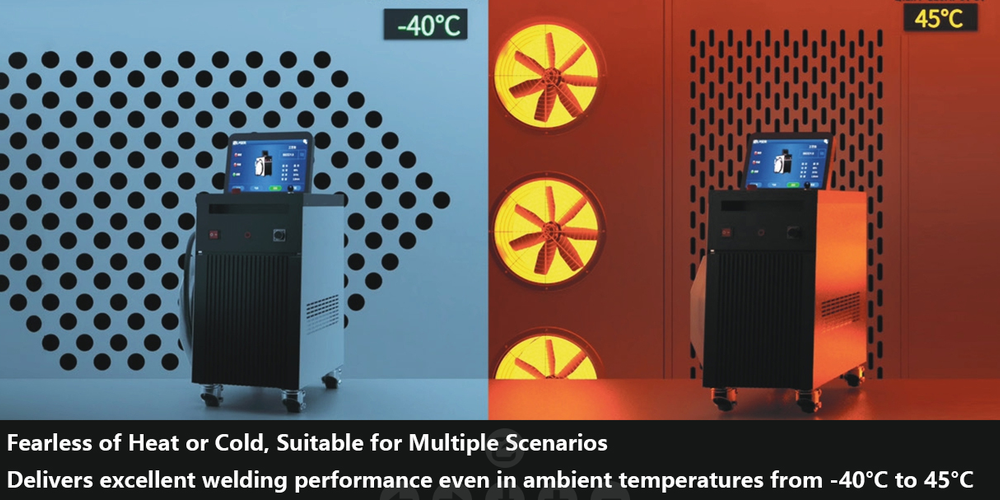
For water-cooled machines, confirm coolant, flow and heat-exchange space before the first production run. For air-cooled machines, confirm airflow and ambient conditions. The manual for the exact model remains the controlling document.
Fault diagnosis: collect evidence before asking for an answer
“Machine not working” is a symptom, not a diagnosis. A useful fault report gives support enough evidence to separate operation, material, parameter, consumable and hardware causes.
Use this minimum dataset:
- Machine model and serial number.
- Error code or exact alarm text.
- What the operator was doing when the fault appeared.
- Material, grade, thickness and joint type.
- Laser mode, power, frequency, pulse width, speed and focus setting.
- Gas type and flow; wire diameter and feed setting if used.
- A close-up photo of the lens, nozzle and weld area.
- A short video showing the screen, sound and actual welding result.
- Whether the fault repeats on a known-good test coupon.
Diagnosis should then follow a controlled sequence:
| Step |
Action |
Output |
| 1 |
Stop production and make the area safe |
No further damage or exposure |
| 2 |
Record the alarm and operating state |
Timestamped fault record |
| 3 |
Check the manual’s pre-checks |
Confirmed or excluded simple causes |
| 4 |
Inspect consumables and connections |
Lens, nozzle, gas, wire and cable condition |
| 5 |
Compare with the commissioning baseline |
Changed parameter or hardware clue |
| 6 |
Send one complete evidence package |
Support recommendation and next action |
| 7 |
Record the fix |
Updated maintenance and fault history |
Do not keep running a machine with an unknown over-temperature, electrical, cooling or optical fault. Stop, isolate and follow the model manual and local safety rules.
Lens replacement, nozzles and consumables
The protective lens is a deliberate barrier between the welding process and more expensive optics. It should be inspected regularly and replaced when contamination, scratching or damage is visible. A contaminated lens can reduce penetration consistency and weld appearance before the machine reports a major failure.
TWI’s guidance on laser-optic cleaning emphasizes suitable handling and cleaning materials; improvising with an unclean cloth or unsuitable solvent can create more damage. Follow the exact lens-handling procedure for the machine and keep spare optics sealed and dry.
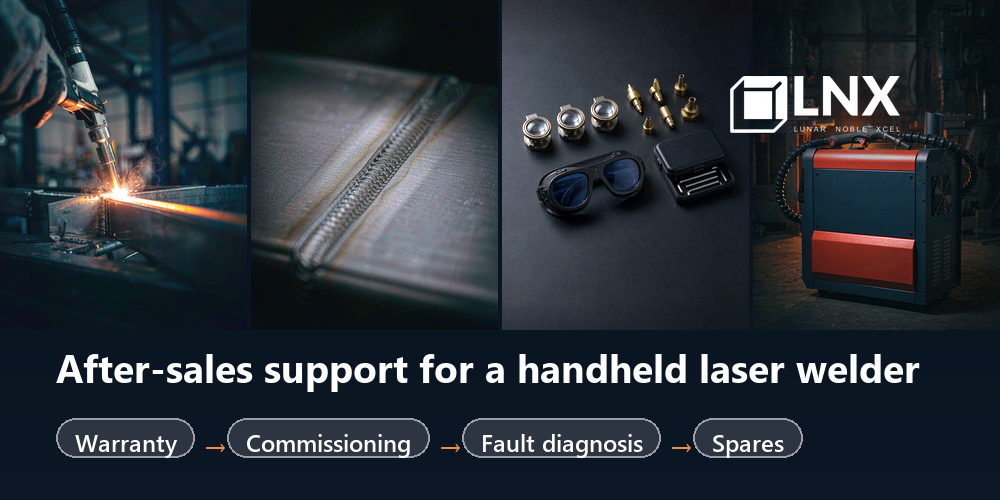
LNX Equipment offers the SPC Spare Parts & Consumables Kit as a configurable maintenance package. Its published standard package includes:
- A basic tool kit.
- An optics set with protective, collimating, focusing, reflecting and motor lenses.
- A welding-gun accessory box.
- A wire-feeder accessory box.
- Laser safety goggles.
- A quick operation guide.
- A troubleshooting reference sheet.
The kit is configured by model, application, production volume and actual consumption. Treat it as a planning framework, not a universal replacement interval. A shop welding dusty galvanized parts may consume protective lenses faster than a clean stainless-steel cell. Record replacement dates and reasons so the next order reflects real use.
Never use consumable replacement to hide a process problem. If lenses fail repeatedly, check gas coverage, spatter direction, nozzle condition, focus, power and operator technique before simply increasing stock.
Spare-parts request: make the first message complete
A spare-parts request should allow the supplier to identify the correct part without guessing. Include:
- Machine model and serial number.
- Part name, number and quantity.
- Photos of the installed part and its connector or mounting point.
- A photo of the machine label.
- The fault symptom and maintenance history.
- Delivery city, postal code and preferred freight account.
- Whether the request is a warranty claim or a paid order.
- The production consequence if the part is delayed.
Ask the supplier to confirm the part number and dispatch basis in writing. For critical wear items, agree a planning target such as dispatch within 48 hours after the fault and part are formally diagnosed. That target is useful only when stock, payment, destination and customs arrangements are also confirmed; it should not be treated as an unconditional delivery guarantee.
For a small shop, a practical starting inventory is one protective-lens set, one nozzle set and the most frequently used wire-feeder parts based on actual consumption. Add a complete configurable SPC kit when the machine runs high duty cycles or operates far from a local parts supplier.
Response channels and time-zone handling
LNX Equipment works from GMT+8. We aims to respond within two hours during business hours; this is an aim, not 24/7 coverage. Response planning should therefore use the buyer’s local clock, not vague phrases such as “during business hours.”
| Channel |
Best use |
What to send |
What to confirm |
| WhatsApp |
Short videos, photos, urgent clarification |
Model, serial number, video, alarm and parameter photo |
Agreed contact and response window |
| Email |
Warranty claims, documents, part orders and longer diagnosis |
Complete fault report and attachments |
Ticket reference and next action |
| Remote video |
Commissioning or a fault that needs a live view |
Stable camera, good light and test material |
Appointment in both time zones |
| Support page |
Manuals and general operating questions |
Exact model before using any document |
Manual revision and applicability |
Avoid splitting one fault across several channels without a summary. Send the evidence once, then use the agreed channel for follow-up. This reduces repeated questions and makes the service record easier to audit.
Five-year maintenance calendar
The calendar below is a planning framework for a standard fabrication shop. The exact tasks and intervals in the model manual and local regulations take priority. Adjust for dust, heat, humidity, gas use, wire feed and duty cycle.
| Period |
Planned focus |
Record to keep |
| Year 1 |
Daily lens, nozzle, gas, cable and cooling checks; establish a monthly baseline weld; review the first consumable replacements |
Commissioning sheet, fault log, first-year wear rate |
| Year 2 |
Review lens and nozzle consumption; inspect cables and connectors; replenish high-use spares; repeat baseline welds |
Part numbers, replacement intervals, parameter history |
| Year 3 |
Review cooling system, filters, gas path and electrical connections; check whether wear rates have changed |
Service findings, photos, corrective actions |
| Year 4 |
Reassess optics, fiber cable, gun housing and feeder condition; update the critical-spares list |
Condition report and revised stock plan |
| Year 5 |
Full support review; compare downtime and maintenance cost with the TCO model; plan refurbishment or replacement of aging items |
Five-year cost record and next-cycle decision |
The five-year plan is not a promise that every component will last five years. It is a way to stop maintenance from becoming reactive. Track three measures: unplanned stops, mean time to restore the process, and consumable cost per accepted meter. Those numbers make the next support conversation factual.
Escalation path when first-line support is not enough
A clear escalation route prevents a local fault from becoming a silent delay.
- Operator check: stop safely, record the alarm and complete the manual pre-checks.
- Maintenance review: inspect power, cooling, gas, lens, nozzle, cable and connections without bypassing safety devices.
- Remote support: submit the complete evidence package and follow the written diagnosis.
- Part replacement: confirm the part number, warranty status and dispatch arrangement before shipment.
- Qualified intervention: if the fault involves internal electrical, optical or cooling work beyond the approved procedure, use a qualified technician authorized for the task.
- Factory escalation: where remote evidence cannot resolve the issue, agree the technical escalation owner, required reports and commercial responsibility in writing.
Define response and escalation times in the order for your own risk model. Do not assume 24/7 coverage, free on-site labour, free freight or a fixed repair time unless those terms appear in the contract.
Support readiness checklist before you order
Use this checklist during supplier comparison:
- Written warranty scope and exclusions received.
- Model-specific manual and manual revision confirmed.
- Remote commissioning scope and buyer responsibilities confirmed.
- On-site service conditions and quotation basis explained.
- Support hours, time zone and escalation contact recorded.
- Fault-report template received.
- Critical spare-parts list and part numbers provided.
- Consumable replacement guidance linked to the actual process.
- Training and safety responsibilities defined.
- Packaging, receiving and damage-report process aligned with Article 4.
- Compliance documents confirmed for the exact model and destination.
- Post-warranty parts and technical-support route confirmed.
If a supplier cannot answer these points before payment, assume the risk will be discovered after payment.
Common mistakes when evaluating laser welder support
- Comparing warranty years without comparing exclusions.
- Assuming remote support includes an on-site engineer.
- Expecting the supplier to diagnose from a single photo of the weld.
- Sending an alarm code without the model, parameters or operating state.
- Keeping no baseline weld after commissioning.
- Buying no protective lenses or nozzles before the first production run.
- Storing spare optics in a humid or dusty workshop.
- Replacing parts repeatedly without finding the process cause.
- Relying on verbal promises for response, freight or escalation.
- Treating the five-year calendar as a warranty extension.
FAQ
What should I check in a handheld laser welding machine warranty?
Check the covered assemblies, exclusions, start date, claim evidence, freight responsibility and escalation route. Confirm the exact model and order terms in writing. Consumables such as protective lenses and nozzles are commonly excluded, so include their replacement cost in your TCO model. Keep the signed warranty with the machine records.
Can handheld laser welding machine installation be supported remotely?
Often, yes, when power, grounding, cooling, gas, ventilation and safety preparations are complete. Remote commissioning should include a checklist, first power-on, agreed test coupon and signed baseline record. Complex electrical, optical or cooling work may require a qualified technician. Confirm the exact remote scope and any on-site conditions before ordering.
Which spare parts should I keep for a handheld fiber laser welder?
Start with protective lenses, nozzles and the wire-feeder parts your process actually consumes. Add sensors, filters or other critical items after reviewing the model manual and failure history. A configurable SPC kit can cover common wear parts. Record replacement dates and keep at least one critical spare set for high-duty or remote operations.
Sources and methodology
This article separates published LNX Equipment service information, product information and general maintenance practice. It does not create a new warranty, response guarantee, free-service promise or fixed repair time. Those terms must be confirmed for the exact model, destination and order.
Next in the series
Request a support and commissioning checklist









One thought on “LNX After-Sales Support: What Happens After You Pay for a Handheld Laser Welder”
One important point when comparing handheld laser welding machines:
A warranty is not the same as a recovery plan.
Before placing an order, confirm:
Which components are covered — and which are consumables?
Who handles remote troubleshooting?
What information is required to diagnose a fault?
Which spare parts should be kept locally?
What are the response hours and escalation procedures?
Who pays for replacement-part freight?
For production shops, the real question is not only “How long is the warranty?”
It is:
“How quickly can we get the machine back to an accepted production state?”
Before purchasing, share your expected duty cycle, destination country and production requirements with the supplier.
A clear support plan can help reduce uncertainty and avoid unnecessary downtime.