Cost & ROI Series | Article 1
Series opening: This is Article 1 of LNX Equipment on the economic benefits of handheld fiber laser welding. S1 covers cost reduction. Later articles cover efficiency, selection, shipping, support and OEM.
Quick answer: The true cost of handheld fiber laser welding is not the purchase price. It is the cost per accepted meter of weld, including installation, labor, energy, consumables, maintenance, rework, downtime and compliance. LNX Equipment recommends building a 7-part TCO model before comparing any handheld laser welding machine with TIG, MIG or another process.
Many fabrication shops start the handheld laser welding cost question incorrectly: “What does the machine cost?” The more useful question is: “What will this process cost for every meter that passes final inspection?” A machine can have a lower purchase price and a higher TCO if it consumes labor, energy, consumables or rework time inefficiently. Another can be easier to justify when it removes finishing, shortens training or increases uptime.
This guide gives you a practical TCO framework for handheld laser welding. It follows the same principle used for industrial equipment evaluation: compare the full process, use measured inputs, and calculate cost per accepted unit rather than cost per machine.
The purchase price is only the first entry
TCO, or total cost of ownership, is the sum of the investment and every material operating, quality and risk cost incurred while the equipment is used. The purchase price is visible, financeable and easy to compare. The other costs are spread across payroll, electricity, consumables, scrap, maintenance and lost production, so they are easier to ignore.
That matters because laser welding changes several cost drivers at once. TWI notes that in thin materials, laser welding can be carried out at speeds of meters per minute, and that the concentrated heat source produces a small weld volume and limited heat input compared with many arc processes (TWI, 2016). Those characteristics can reduce distortion and finishing work, but the saving depends on joint fit-up, material, thickness and operator skill.
Laser welding is not automatically cheaper than TIG. Calculate both processes using the same work package. If the operation has only occasional short welds, complex out-of-position joints or very low annual weld length, the payback may be weak. If it has repeatable thin-gauge seams, visible welds and a shortage of skilled welders, the economics can be very different. TWI reports that an aging welding workforce and difficulty recruiting skilled welders are already affecting employers in developed markets (TWI, 2023).
The 7 costs that determine handheld laser welding TCO
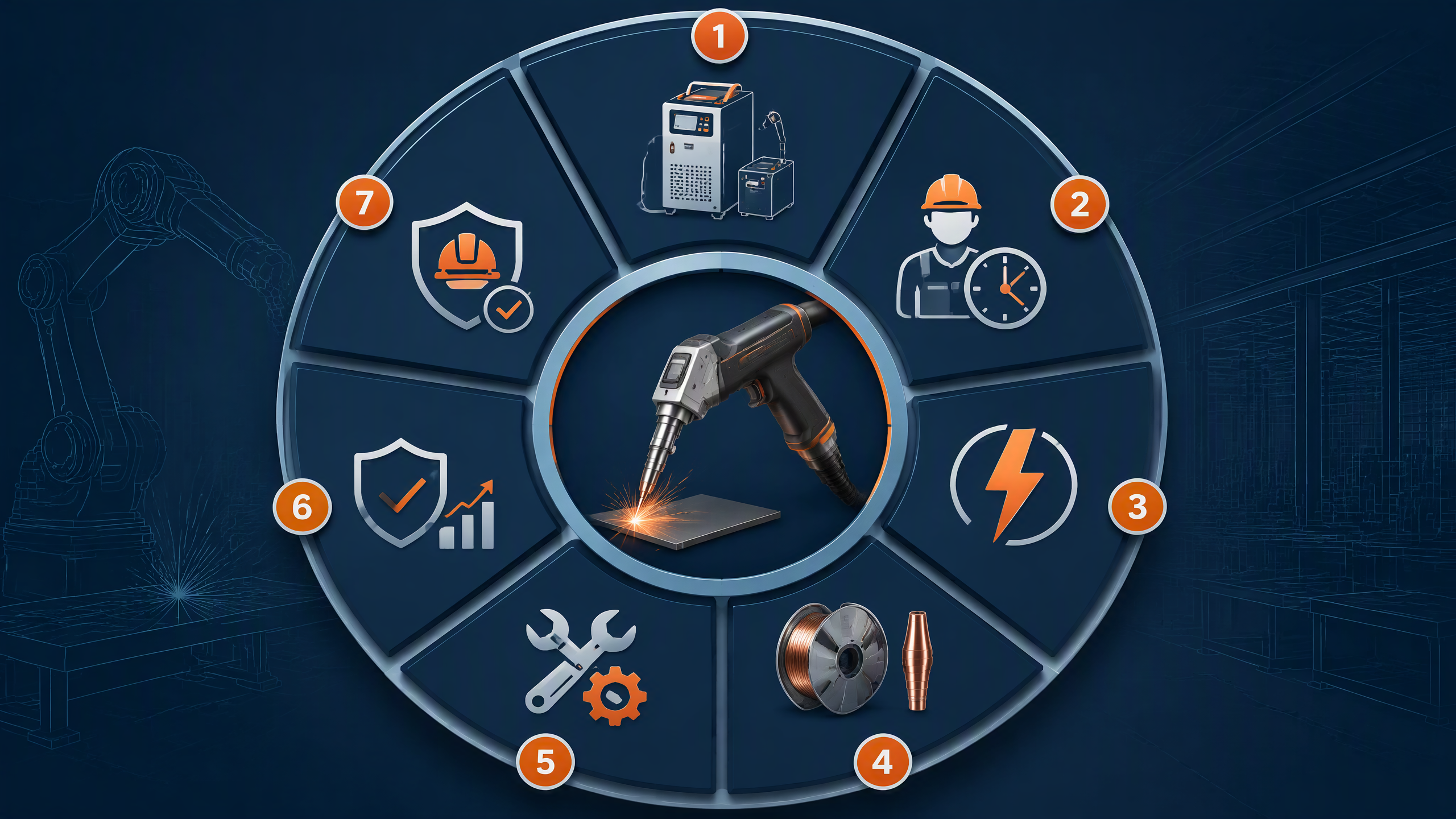
Use the table below as the structure of your TCO model. Every category should be converted into an annual cost and then divided by annual accepted weld meters.
| # |
Cost category |
What to include |
Data to collect |
Why it changes the decision |
| 1 |
Installed acquisition |
Machine package, delivery, duties, installation, fixture changes, training, commissioning and financing |
Quoted installed cost, payment terms, commissioning days, fixture cost |
Purchase price alone hides the cost of making the process production-ready |
| 2 |
Labor and utilization |
Arc-on time, setup, loading, tacking, cleaning, inspection, paid breaks and rework hours |
Time study, fully-burdened labor rate, annual weld meters, utilization |
Labor is usually the largest controllable cost in manual welding |
| 3 |
Electrical energy |
Laser source, chiller, controls, fume extraction, compressed air and standby consumption |
Measured average input kW, productive hours, local electricity tariff |
Rated laser power is not the same as measured electrical input |
| 4 |
Consumables |
Filler wire, shielding gas, protective lenses, nozzles, filters and test material |
Consumption per accepted meter or per shift, replacement interval, unit cost |
Small consumables become material when volume and downtime are high |
| 5 |
Maintenance and downtime |
Preventive maintenance, optics care, spare parts, service visits and lost contribution margin |
Maintenance schedule, spare-parts list, mean time to repair, downtime cost per hour |
Reliability affects both repair cost and lost production |
| 6 |
Rework and quality |
Grinding, polishing, porosity, cracks, spatter, scrap, inspection, NDT and warranty work |
Defect rate, repair minutes, scrap value, inspection frequency, acceptance criteria |
A fast first pass has little value if the part must be repaired or rejected |
| 7 |
Safety, training and compliance |
Eye protection, barriers, interlocks, fume control, training, risk assessment and documentation |
Training hours, PPE replacement, extraction energy, compliance review |
Laser safety is a real operating cost and an essential condition of use |
Figure 1: The 7-part TCO framework. Every category must be converted into an annual cost and divided by accepted weld meters.
1. Installed acquisition cost
Build the capital number as “installed and production-ready”, not “machine delivered”. Include the equipment package, freight, import charges, internal handling, fixture or positioner changes, commissioning, operator training and any electrical work. If the supplier quotes optional wire feeders, cooling equipment, safety glasses, extraction or spare lenses separately, add them to the comparison.
Do not compare a machine price without a scope list. A lower-cost package may exclude the accessories that make a process repeatable. A higher-cost package may include training and commissioning that remove weeks of trial and error. The correct comparison is like-for-like scope, warranty and support.
2. Labor and utilization
Start with a time study, not a sales claim. Measure one representative part family and separate:
- Setup and changeover time.
- Load, unload and fixture time.
- Tack or fit-up time.
- Arc-on or laser-on time.
- Cleaning, grinding and polishing time.
- Inspection and rework time.
- Waiting time caused by fit-up, programming or material issues.
The formula is:
Annual labor cost = paid process hours × fully burdened labor rate
Fully burdened labor includes wages, payroll taxes, benefits, supervision, training and paid non-productive time. Do not use the hourly wage alone.
Utilization is equally important. A process with a higher travel speed can still have a weak payback if setup and handling dominate the cycle. Measure total cycle time and cost per accepted part, not only the speed on a straight test coupon.
TWI describes laser welding as a fast process that is well suited to high-productivity environments, while noting that the speed depends on the laser type, power and material. On a manual handheld operation, the practical speed is also limited by operator control, joint access and safety (TWI, 2016). Treat published speeds as a starting hypothesis and confirm the number on your own part. Check material and thickness factors in our Handheld Laser Welder Power Guide.
3. Electrical energy
The nameplate laser power is an output rating, not the total electrical demand. For an annual energy calculation, use a power meter and record average input kW during a representative production cycle. Include the chiller, control cabinet, extraction system, compressed-air demand and standby consumption.
Annual electricity cost = measured average input kW × annual operating hours × electricity tariff
Measure the two processes over the same work package. A laser may use less energy during welding, but an undersized extraction system or an oversized chiller can erode the advantage. Energy is often easier to measure than labor, but it is usually not the largest saving. Use it as a verified input, not as the main investment case.
4. Consumables
Consumables should be tracked per accepted meter, not per purchase order. The main items are:
- Filler wire and shielding gas.
- Protective lenses and nozzles.
- Filters and cooling consumables.
- Test coupons and destructive-test samples.
- Cleaning materials and replacement fixtures.
TWI notes that adding cold filler wire can reduce welding speed by roughly 10% to 20% at a given laser power because energy is required to melt the wire. Higher available power, heated wire or a hybrid process can offset part of that reduction (TWI, 2016). This is why a consumable comparison must include both material consumption and its effect on cycle time.
A wire feeder is not automatically a cost. It can improve fit-up tolerance and help control cracking in some joints. The decision should be based on the joint, acceptance criteria and total process time. For a deeper review of feeder configurations, see our wire feeder systems guide.
5. Maintenance and downtime
Ask for a maintenance schedule and a spare-parts list before purchase. Then convert the schedule into annual cost:
Annual maintenance cost = planned service cost + expected replacement-parts cost + downtime hours × contribution margin per hour
Optics care is a good example. TWI states that laser optics should be cleaned as often as necessary, with frequency determined by the operating environment, and that neglect can be expensive in both performance and cost (TWI, 2015). A lower-cost machine that damages lenses more often can have a higher TCO.
Downtime must be valued correctly. The cost is not only the repair invoice. It is also the contribution margin lost while a production cell is stopped. If one hour of downtime delays a batch by one hour, use the shop’s contribution margin per production hour. If the machine is not a bottleneck, use the actual idle-labor cost instead. Do not apply the same downtime rate to every cell.
6. Rework and quality cost
TWI explains that laser welds can contain defects such as solidification cracking and porosity when materials and parameters are not properly controlled, while other defects such as excessive distortion may be less likely (TWI, 2016). For a TCO model, convert those risks into four numbers:
- Defect rate by part family.
- Minutes required to inspect and repair one defect.
- Scrap or replacement-material value.
- Lost production caused by rework.
Annual quality cost = defect rate × accepted units × repair minutes × burdened labor rate + scrap + inspection + warranty
A clean weld can remove grinding and polishing, but only when the joint design, material condition and process window support it. Test the actual worst-case part, not only a polished demonstration coupon.
7. Safety, training and compliance
Laser welding introduces beam, reflection and non-beam hazards. OSHA identifies engineering controls, administrative controls and personal protective equipment as the main control layers for laser hazards (OSHA). The Laser Institute of America states that ANSI Z136.1 is the foundation of laser safety programs and is referenced by OSHA, while industrial training covers hazard assessment and controls for materials-processing environments (LIA, LIA training).
Build these items into the annual budget:
- Risk assessment and safe operating procedure.
- Laser safety eyewear appropriate to the wavelength and optical density.
- Barriers, curtains, interlocks and controlled access.
- Fume extraction and verification.
- Operator and supervisor training.
- Record keeping, inspection and refresher training.
Do not treat this as an optional add-on. An incomplete safety scope can delay commissioning, restrict production or create a much larger liability.
The TCO formula to use
For each process, calculate:
Lifecycle TCO = net installed investment + total direct operating cost + total quality and risk cost over the evaluation period
Where:
Annualized TCO = lifecycle TCO ÷ number of evaluation years
Annual direct operating cost = annual labor + annual energy + annual gas and wire + annual optics and consumables + annual maintenance
Cost per accepted meter = lifecycle TCO ÷ accepted weld meters over the same period
Use the same part family, labor rate, utilization, acceptance criteria and production volume for both processes. If the two processes cannot produce the same quality level on the same part, the comparison is not valid.
Worked example: identify the real cost driver
The numbers below are planning assumptions, not a guarantee or a quotation. Replace every value with your measured data.
| Result |
TIG |
Handheld fiber laser |
Difference |
| Arc-on or laser-on hours |
555.6 h |
138.9 h |
416.7 h |
| Paid process hours at 75% utilization |
740.7 h |
185.2 h |
555.5 h |
| Annual labor cost |
$25,925 |
$6,482 |
$19,443 |
| Annual electricity cost |
$833 |
$87 |
$747 |
| Labor plus electricity |
$26,758 |
$6,569 |
$20,190 |
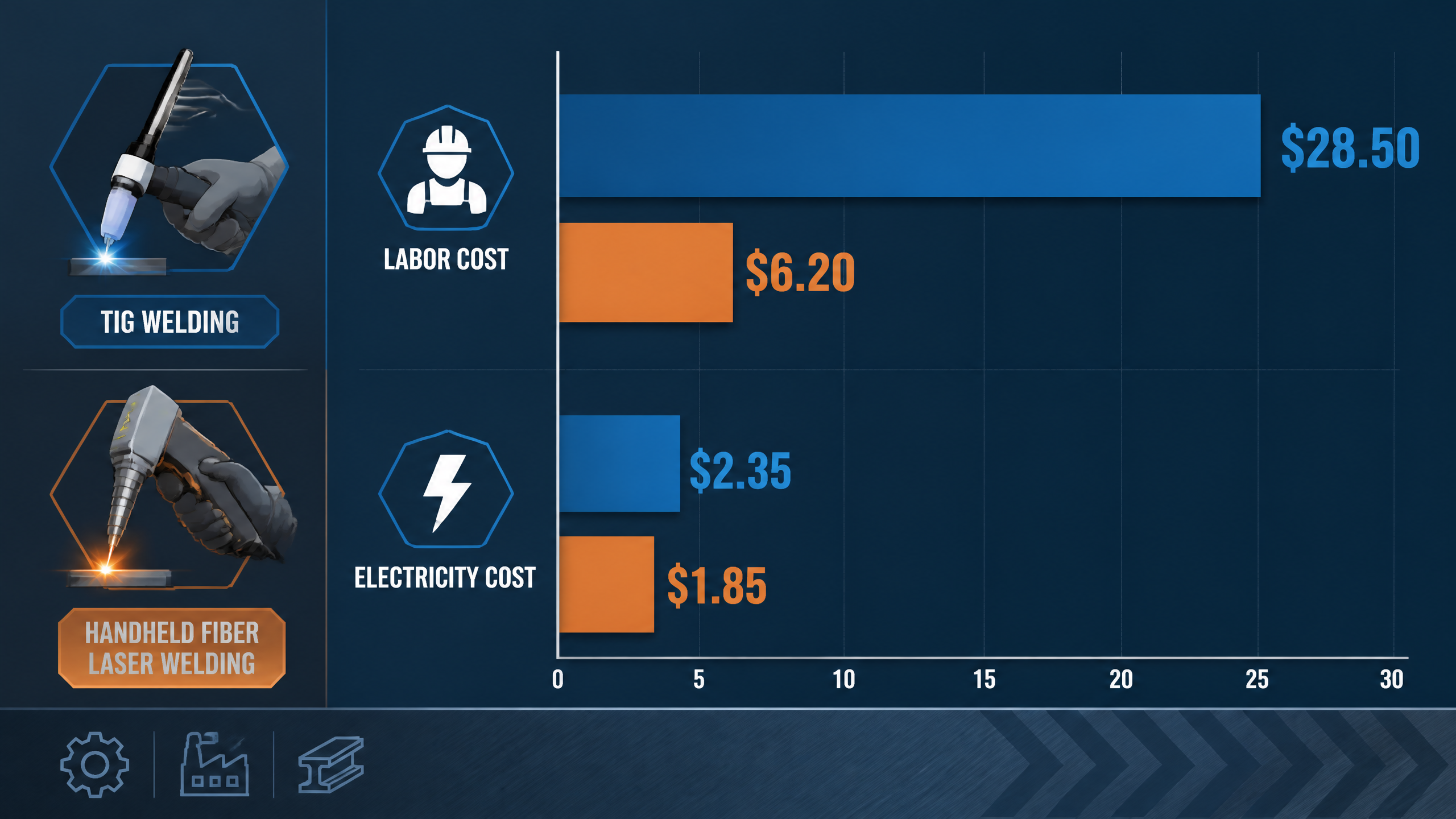
The example shows why handheld laser welding cost should be evaluated as a process cost. In this scenario, labor dominates the potential saving. Energy contributes less than 4% of the combined difference. The next step is to subtract consumables, maintenance, training and any additional fixture cost, then add rework, scrap and downtime avoided. Do not present the gross difference as net savings.
Figure 2: Worked example cost comparison. Labor dominates the potential saving; energy is a smaller factor.
If the laser cannot achieve 1.2 m/min on the actual joint, or if setup and finishing take the same time as TIG, the payback changes immediately. That is why the model must remain editable.
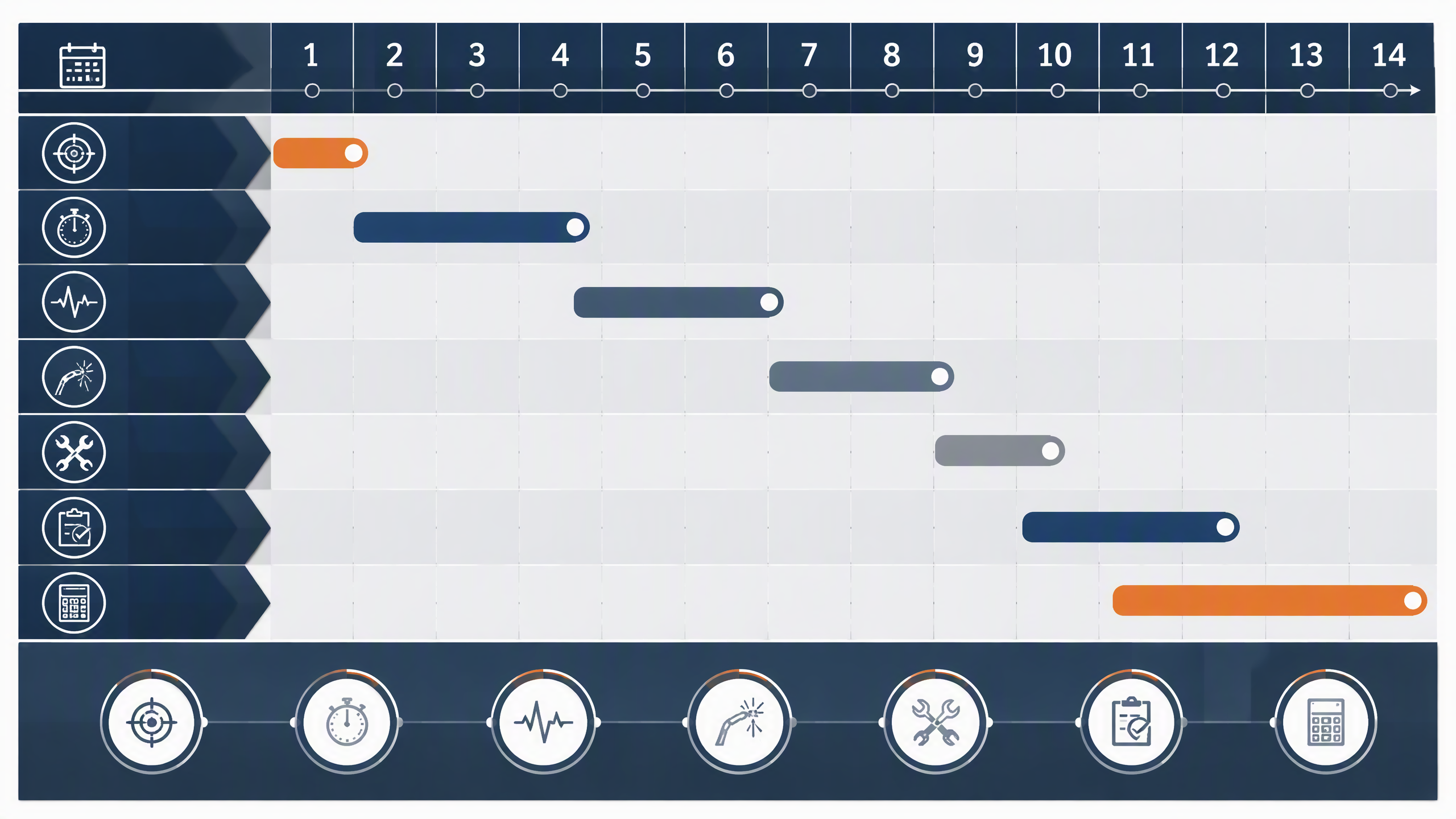
How to collect reliable data in 14 days
| Day |
Action |
Output |
| 1 |
Select one representative part family and one trained operator |
Defined comparison scope |
| 2–4 |
Time 20 parts or at least 100 m of weld per process |
Setup, handling, arc-on, cleaning and inspection times |
| 5 |
Measure electrical input and auxiliary loads |
Average kW per process |
| 6 |
Weigh or count wire, gas and lens consumption |
Consumption per accepted meter |
| 7 |
Review maintenance records and spare-parts usage |
Annual maintenance estimate |
| 8–10 |
Inspect 100% of the sample to the customer’s acceptance criteria |
Defect, rework and scrap rate |
| 11 |
Calculate labor, energy, consumable and quality costs |
Draft annual TCO |
| 12 |
Add training, PPE, extraction and downtime costs |
Risk-adjusted TCO |
| 13 |
Repeat with the second process using identical assumptions |
Comparable result |
| 14 |
Review the result with production, quality and finance |
Approved investment decision |
Figure 3: 14-day data collection roadmap. A directional model with visible assumptions is more useful than a precise model built on the wrong scope.
If 14 days is not practical, start with a one-page model for one product family. A directional model with visible assumptions is more useful than a precise model built on the wrong scope.
When handheld laser welding is likely to reduce cost
The strongest business case usually appears when several of these conditions are true:
- The shop welds long, repeatable seams in thin or medium-gauge material.
- Distortion, heat tint, grinding or polishing currently consumes significant labor.
- Skilled TIG welders are difficult to recruit or retain.
- The part mix allows fixture and parameter standardization.
- Annual accepted weld length is high enough to justify training and setup.
- Quality can be confirmed with a practical inspection plan.
- The supplier provides a test weld on the customer’s material and joint.
The case is weaker when the shop has low annual weld length, very thick sections, difficult out-of-position access, poor fit-up, frequent material changes or no maintenance capability. In those cases, TIG, MIG, hybrid laser-arc welding or outsourcing may still be the lower-cost solution. A professional TCO model should be able to say “not yet”.
Seven red flags in a handheld laser welding ROI calculation
- The supplier gives a payback number without showing labor rate, utilization and annual weld length.
- The comparison uses rated laser power as electricity consumption.
- Labor is calculated from wages only, without benefits, supervision and non-productive time.
- Setup, fixture changes, loading and inspection are excluded.
- Savings assume 100% utilization and zero downtime.
- Rework, scrap, finishing, NDT and warranty are treated as zero.
- Consumables, optics, extraction and training are missing from the annual cost.
If one of these inputs is unknown, label it as an assumption and run a low, base and high case. A decision made with visible uncertainty is safer than a single optimistic number.
FAQ: handheld laser welding cost and TCO
Is handheld laser welding cheaper than TIG welding?
It depends on cost per accepted meter, not purchase price. Laser welding may reduce labor, finishing and distortion on repeatable thin-gauge work, while TIG can remain more economical for low-volume, thick-section or difficult out-of-position joints. Compare both processes using measured cycle time, labor burden, energy, consumables, rework and downtime.
How much electricity does a handheld laser welder use?
Use measured average input kW, not rated output power. Multiply average input kW by annual operating hours, then add the chiller, extraction, controls and standby consumption. A 1,500 W laser source may draw more than 1,500 W from the wall after conversion losses; average cycle draw can differ, so a meter is more reliable than a nameplate.
What hidden costs are most often missed?
The most common omissions are setup and fixture time, grinding and polishing, rework and scrap, optics and consumables, downtime, extraction energy, operator training and compliance work. These costs rarely appear in a purchase quotation, but they determine the real cost per accepted meter and the payback period.
Sources and methodology
Last reviewed: 16 September 2026.
This article separates external technical evidence, editable planning assumptions and LNX Equipment’s proposed TCO framework. The worked example is arithmetic based on the stated assumptions; it is not a measured customer result. Performance must be confirmed on the actual material and joint.
Next in the series




One thought on “Handheld Laser Welding Cost: The 7-Part TCO Framework 2026”
A practical note for buyers: TCO is only useful when the machine matches your actual production conditions.
Before choosing a handheld laser welder, we recommend checking these points:
• Cooling: Air-cooled systems suit intermittent workshop welding and lower-duty applications. Water-cooled systems are generally better for long, continuous production and higher thermal loads.
• Laser power: Don’t choose 2000W simply because it is more powerful. The right power depends on material, thickness, joint design, welding speed and daily workload.
• Payback: A simple way to estimate payback is:
Payback Period = Net Machine Investment ÷ Annual Net Savings
• Application fit: Laser welding is not automatically the most economical option for every job. Welding volume, joint fit-up, operator skill, rework rate and production requirements all matter.
Need help selecting the right configuration?
Send us just 3 details — material, thickness and approximate welding hours per day. We can help you narrow down the suitable power and cooling configuration for your application.
🔗 https://lnxequipment.com/